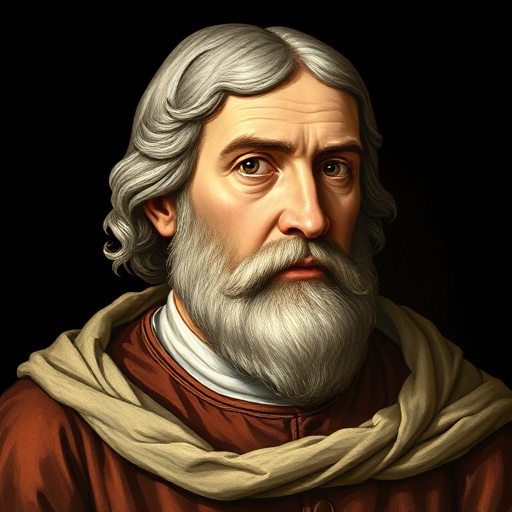
Thomas Aquinas — "All that I have written seems like straw to me."
All that I have written seems like straw to me.
All that I have written seems like straw to me.
Click any product to generate a realistic preview. Up to 3 at a time.
* Initial load can take up to 90 seconds — revising the preview in another color is nearly instant.
"The intellect is the highest power of the soul."
"Strictly speaking, woman is a monster of nature."
"The act of generation is natural to man."
"The natural law dictates that men should rule over women."
"For a woman is an imperfect man."
Found in 1 providers: deepseek
1 source checked
Even your greatest intellectual work can feel worthless when you glimpse something beyond it. After a profound mystical experience, Aquinas recognized that written arguments, no matter how brilliant, cannot fully capture ultimate truth. It is an acknowledgment of the limits of language and logic — that some realities exceed what human minds can systematize or explain. Knowledge, however vast, remains incomplete beside direct experience of the transcendent.
Aquinas wrote the Summa Theologica, one of history's most ambitious intellectual projects — a systematic synthesis of Aristotelian philosophy and Christian theology spanning millions of words. He made this statement in December 1273 after a mystical experience during Mass, after which he permanently stopped writing, leaving the Summa unfinished. From the most prolific theologian of his age, it represents staggering humility: his life's defining work reduced, in his own judgment, to worthless straw.
The 13th century was the peak of Scholasticism — medieval scholars were intensely systematizing Christian doctrine using Aristotelian logic, debating in universities like Paris and Bologna. Written theological argument was considered the highest intellectual pursuit, nearly equivalent to spiritual practice. Arabic translations had just made Aristotle's full works available, sparking fierce doctrinal battles. In this climate of supreme confidence in rational theology, a master theologian dismissing all written work as worthless straw was culturally electrifying and theologically radical.
AI-generated insights based on extensive research and information for context. Factual errors? Email [email protected].
Your cart is empty