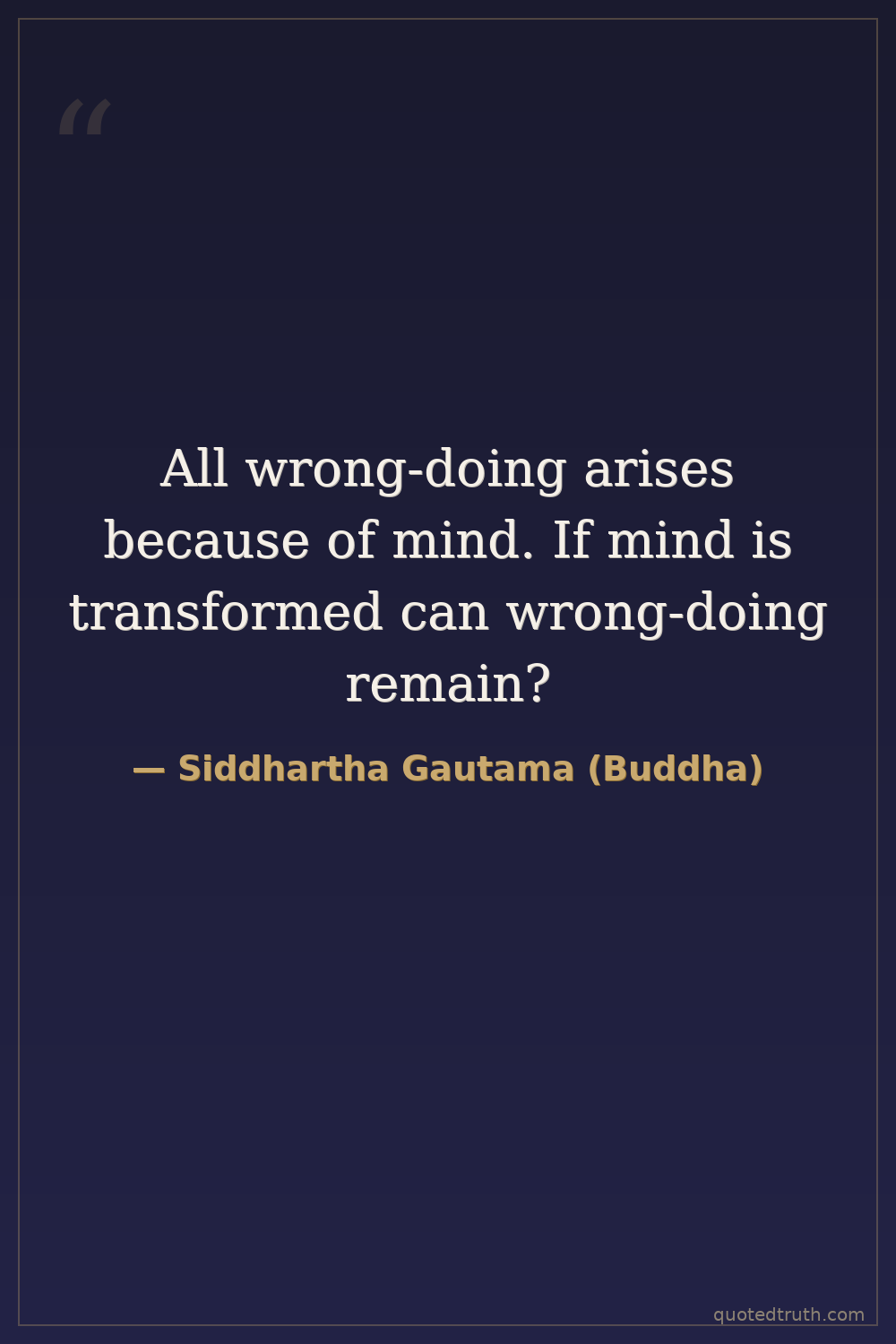
Siddhartha Gautama (Buddha) — "All wrong-doing arises because of mind. If mind is transformed can wrong-doing r…"
All wrong-doing arises because of mind. If mind is transformed can wrong-doing remain?
All wrong-doing arises because of mind. If mind is transformed can wrong-doing remain?
Click any product to generate a realistic preview. Up to 3 at a time.
* Initial load can take up to 90 seconds — revising the preview in another color is nearly instant.
"It is a man's own mind, not his enemy or foe, that lures him to evil ways."
"Hatred does not cease by hatred, but only by love; this is the eternal rule."
"Just as a candle cannot burn without fire, men cannot live without a spiritual life."
"If you find no one to support you on the spiritual path, walk alone. There is no companionship with the immature."
"What you are is what you have been, and what you will be is what you do now."
Found in 1 providers: gemini
1 source checked
Every harmful action starts in the mind before it becomes behavior. Bad choices, cruelty, and destructive habits all trace back to thoughts, intentions, and mental states like greed, anger, or ignorance. Change the source, and the output changes automatically. If you genuinely retrain how your mind perceives and reacts, wrongdoing loses its fuel. You can't keep acting badly once the mental patterns driving those actions have been rewired into clarity and compassion.
This captures the heart of the Buddha's teaching after his enlightenment under the Bodhi tree. Born a prince around 563 BCE, he renounced luxury to investigate suffering and concluded its roots lay in mental craving and delusion, not external circumstances. His Eightfold Path begins with Right View and Right Intention because he saw mind as the forge of karma. He spent 45 years teaching meditation and mindfulness as the tools for transforming the mind itself.
In the 6th-5th century BCE northern India, Vedic Brahmanism dominated through ritual sacrifice, caste hierarchy, and priestly authority, teaching that purity came from external ceremonies. The Buddha arose during the Shramana movement, a wave of wandering ascetics questioning ritual religion. His claim that liberation depended on inner mental transformation, accessible to anyone regardless of caste, was radical. It shifted moral responsibility from gods and priests to the individual's own consciousness, reshaping Indian spiritual thought.
AI-generated insights based on extensive research and information for context. Factual errors? Email [email protected].
Your cart is empty