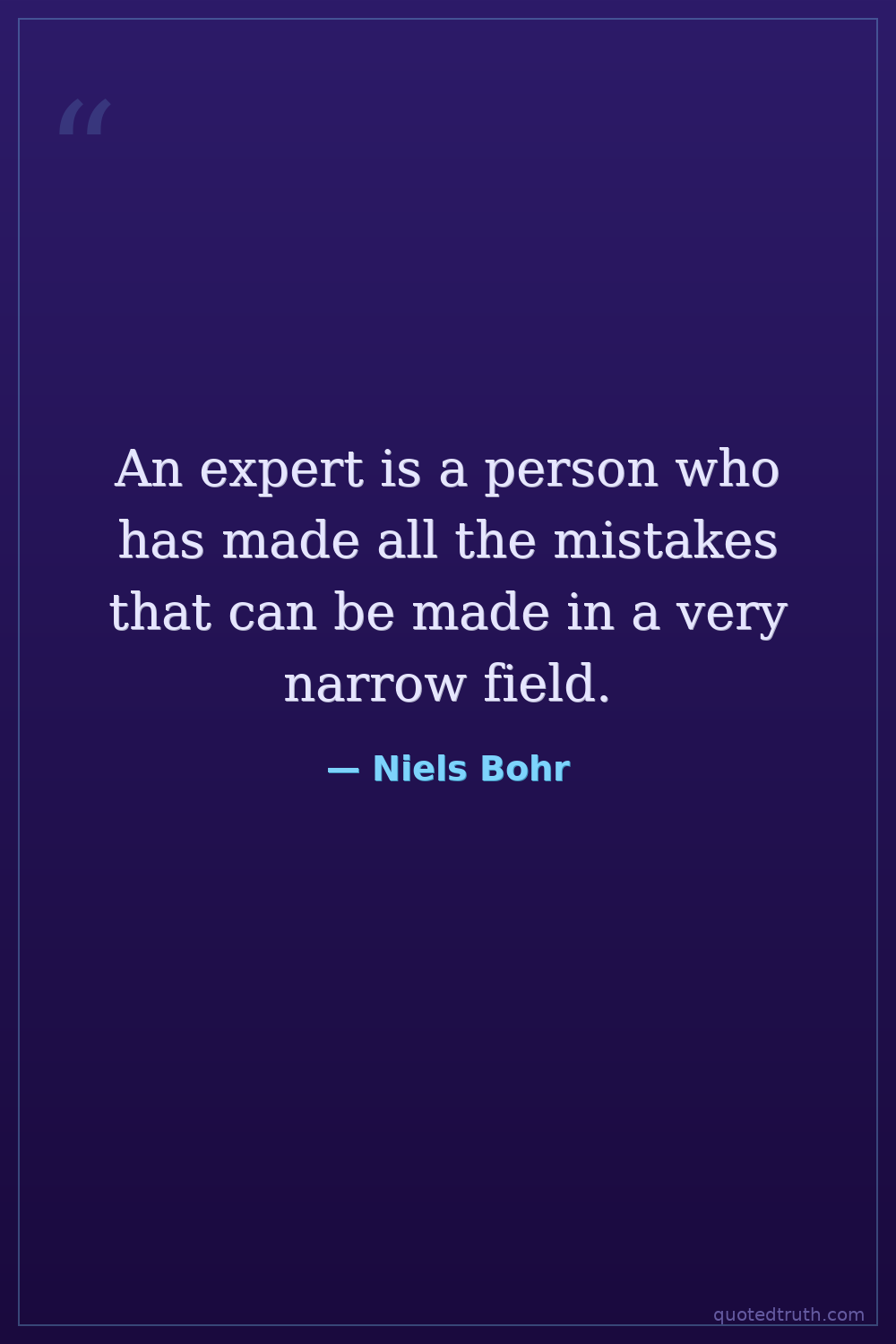
Niels Bohr — "An expert is a person who has made all the mistakes that can be made in a very n…"
An expert is a person who has made all the mistakes that can be made in a very narrow field.
An expert is a person who has made all the mistakes that can be made in a very narrow field.
Click any product to generate a realistic preview. Up to 3 at a time.
* Initial load can take up to 90 seconds — revising the preview in another color is nearly instant.
"The fundamental problem of all science is the description of the world."
"Truth and clarity are complementary."
"The goal of science is to make sense of the world, not to explain it away."
"The ultimate goal of science is to understand the universe and our place in it."
"We are all in the same boat, in a stormy sea, and we owe each other a terrible loyalty."
Found in 3 providers: grok,deepseek,gemini
3 sources checked
True expertise comes from extensive trial and error, not innate talent or textbook knowledge. Someone becomes an expert by working so deeply within a specialized area that they have personally encountered and failed at every possible pitfall. Mastery is defined by accumulated failure in a tight scope, and the narrower the focus, the more exhaustive that firsthand error catalog becomes. Wisdom, in other words, is compressed failure.
Bohr spent decades wrestling with atomic structure, quantum theory, and wave-particle duality, revising his own 1913 atomic model repeatedly as experiments contradicted it. He famously debated Einstein for years over quantum mechanics, often being wrong before being right. His Copenhagen Institute trained generations through open argument and productive error. For Bohr, physics advanced through mistakes publicly made and corrected, a philosophy this quote distills exactly.
Bohr worked through the early-to-mid 20th century, when physics was being rebuilt from scratch. Classical mechanics had just collapsed under relativity and quantum discoveries, and scientists were groping through genuine unknowns. The Manhattan Project, Nazi occupation of Denmark, and postwar nuclear ethics forced physicists into rapid, high-stakes decisions. In that climate, humility about error was not modesty but survival, shaping a scientific culture that prized honest failure over false certainty.
AI-generated insights based on extensive research and information for context. Factual errors? Email [email protected].
Your cart is empty