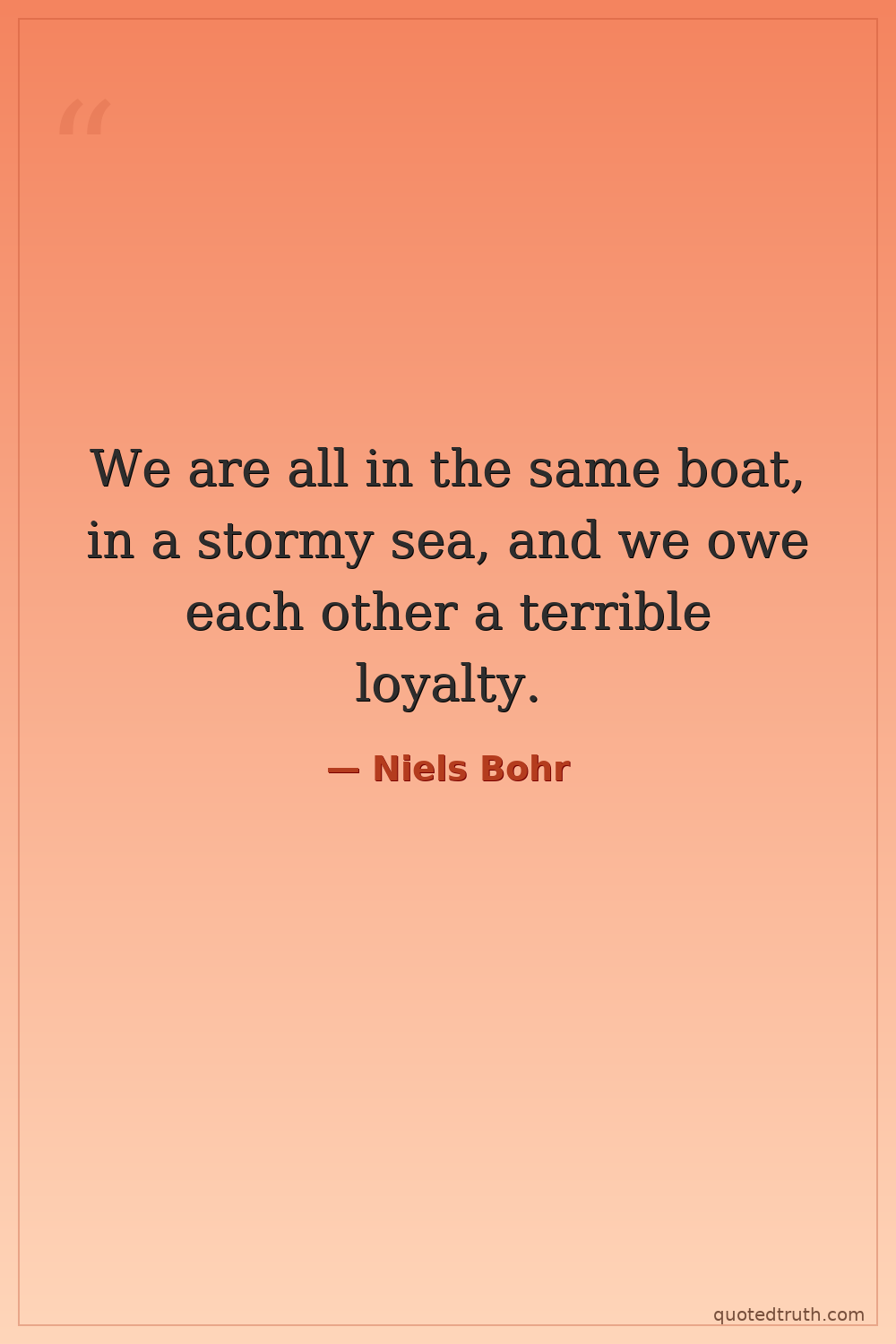
Niels Bohr — "We are all in the same boat, in a stormy sea, and we owe each other a terrible l…"
We are all in the same boat, in a stormy sea, and we owe each other a terrible loyalty.
We are all in the same boat, in a stormy sea, and we owe each other a terrible loyalty.
Click any product to generate a realistic preview. Up to 3 at a time.
* Initial load can take up to 90 seconds — revising the preview in another color is nearly instant.
"Every great and deep difficulty bears in itself its own solution. It forces us to change our thinking in order to find it."
"We are suspended in language. Our task is to communicate experience and ideas to others."
"The universe is not only stranger than we imagine, it is stranger than we can imagine."
"Science is not about certainty; it is about uncertainty."
"The only way to avoid error is to acquire experience, and the only way to acquire experience is to make errors."
From a letter or conversation, expressing a sense of shared humanity and responsibility.
Date: Mid 20th century
GeneralFound in 1 providers: grok
1 source checked
Shared danger erases the illusions that divide us. When the sea turns stormy, survival depends on everyone in the boat regardless of nationality, belief, or status. 'Terrible' here means solemn and immense, not frightening. The quote insists mutual loyalty is not optional sentiment but a binding obligation — owed precisely because none of us can escape our shared exposure to the same risks and catastrophes bearing down on all of humanity equally.
Bohr fled Nazi-occupied Denmark in 1943, watching borders become meaningless as civilization itself was threatened. As a key Manhattan Project contributor who then campaigned urgently for nuclear non-proliferation, he understood shared existential risk viscerally and personally. His Copenhagen Interpretation championed complementarity — opposing views together reveal fuller truth — reflecting the same spirit of interdependence this quote demands. In 1950 he wrote the UN an open letter urging international atomic cooperation as humanity's only viable path to survival.
The early-to-mid 20th century delivered two world wars, the Holocaust, and the nuclear age in rapid succession. Scientists watched their discoveries weaponized at civilization-ending scale. The Cold War then split the world into hostile camps even as hydrogen bombs made mutual annihilation real. The UN was being constructed precisely because leaders recognized no nation could survive alone. Solidarity stopped being idealism and became strategic necessity — the only rational response to weapons that respected no borders.
AI-generated insights based on extensive research and information for context. Factual errors? Email [email protected].
Your cart is empty