What it means
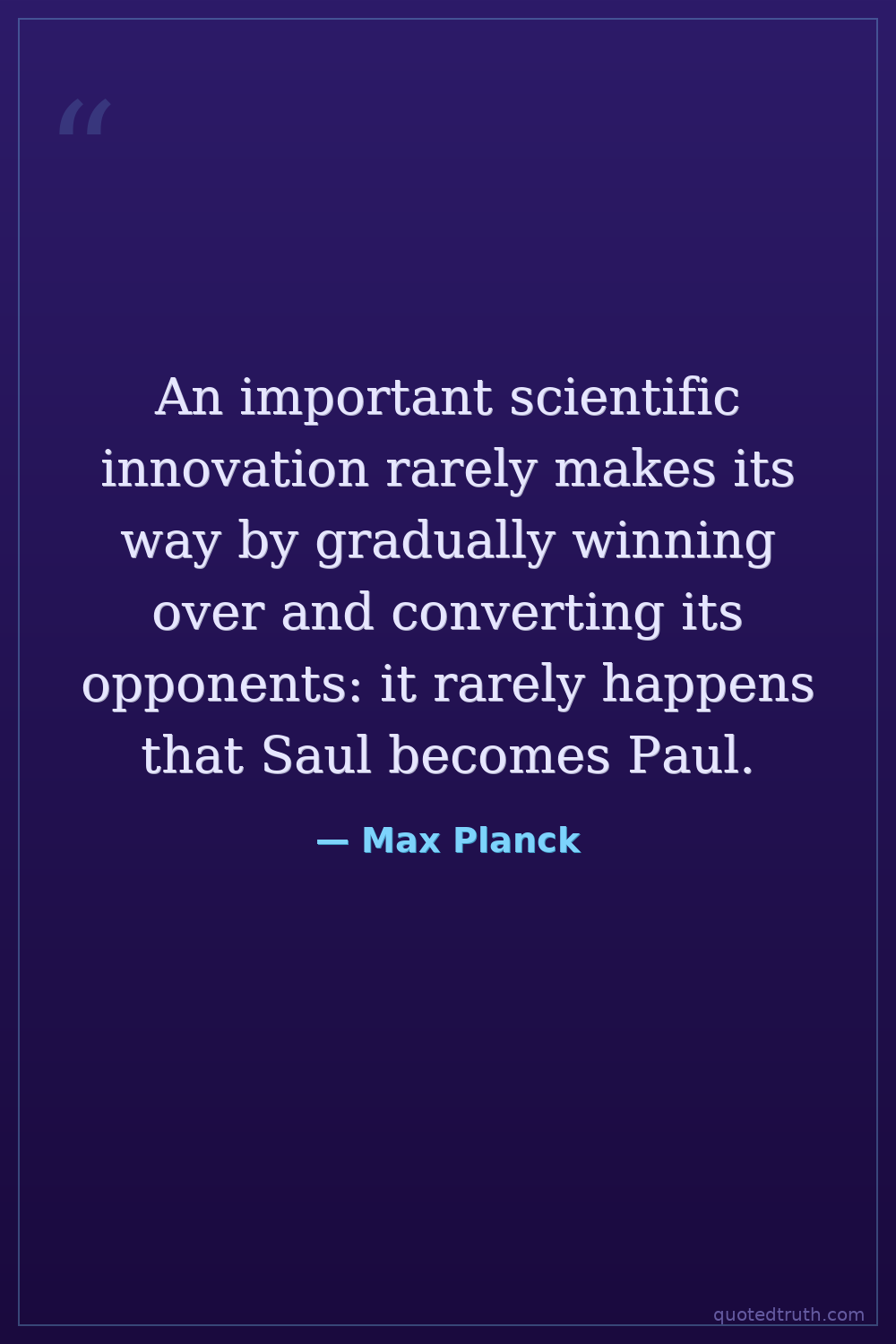
New scientific ideas seldom triumph by persuading those who reject them. Opponents rarely experience a dramatic reversal of conviction, flipping from critic to champion. Instead, entrenched thinkers typically cling to their established views until they retire or die, while a younger generation, unburdened by old commitments, simply grows up accepting the new framework. Progress advances through generational turnover, not through argument converting the unconvinced.
Relevance to Max Planck
Planck lived this firsthand. His 1900 quantum hypothesis broke classical physics, yet senior physicists resisted for decades while younger scientists like Einstein, Bohr, and Heisenberg ran with it. Trained as a classical thermodynamicist, Planck himself initially hesitated to accept his own radical implications. Having watched peers refuse quantum reality until they died, he distilled this hard-won observation into what became known as Planck's principle: science advances one funeral at a time.
The era
Planck wrote this amid the early 20th-century revolution overturning Newtonian certainty. Quantum mechanics and relativity shattered classical physics between 1900 and 1930, splitting the community between old guard and new. Planck witnessed bitter debates, Nazi attacks on 'Jewish physics,' and the slow institutional acceptance of ideas once dismissed as absurd. His era proved that paradigm shifts, later formalized by Kuhn in 1962, depended less on evidence persuading skeptics than on demographic replacement within scientific institutions.
AI-generated insights based on extensive research and information for context. Factual errors? Email [email protected].