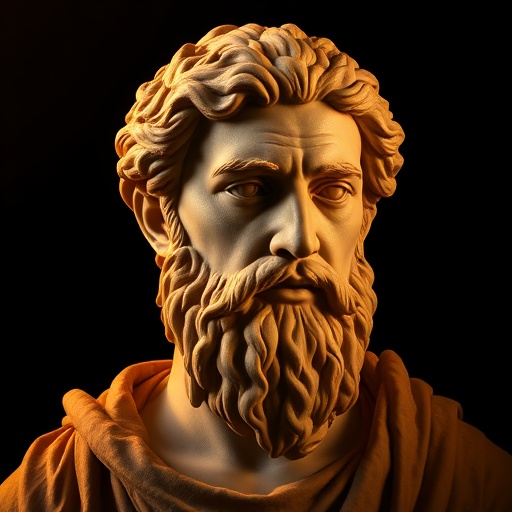
Euclid — "To draw a straight line from any point to any point."
To draw a straight line from any point to any point.
To draw a straight line from any point to any point.
Click any product to generate a realistic preview. Up to 3 at a time.
* Initial load can take up to 90 seconds — revising the preview in another color is nearly instant.
"Parallelograms which are on the same base and in the same parallels are equal to one another."
"If a straight line be cut into two equal parts and also into two unequal parts, the rectangle contained by the unequal parts together with the square on the line between the points of section is equal…"
"If a number be the least that is measured by any prime numbers, it will not be measured by any other prime number except those originally measuring it."
"And the point is called the center of the circle."
"Rectilinear figures are those which are contained by straight lines, trilateral figures being those contained by three, quadrilateral those contained by four, and multilateral those contained by more …"
Found in 1 providers: grok
1 source checked
Any two points in space can be connected by exactly one straight line — the simplest possible geometric fact. Euclid chose it as his first axiom to build all geometry from scratch. Its power is its self-evidence: no proof required, just acceptance. From this sentence, combined with four other postulates, he derived hundreds of theorems that defined how humans understood physical space for over two thousand years.
Euclid wrote Elements around 300 BCE — the most-used mathematics textbook in history, studied continuously for over 2,000 years. His entire method depended on selecting the right starting axioms: undeniable truths requiring no proof. This first postulate reveals his genius for stripping ideas to bare essentials. He didn't invent geometry but systematized it, and opening with this axiom reflects his conviction that rigorous reasoning must begin from the simplest, irreducible truth.
Around 300 BCE, Alexandria under Ptolemy I was becoming the ancient world's intellectual capital, home to the great Library. Greek thinkers were actively systematizing all knowledge, but no standardized mathematical curriculum existed — contradictory proofs circulated freely. Plato's Academy had made geometry central to educated life. Euclid's task was establishing a single, logically airtight foundation at the precise historical moment when formal axiomatic reasoning itself was being invented as a discipline.
AI-generated insights based on extensive research and information for context. Factual errors? Email [email protected].
Your cart is empty