What it means
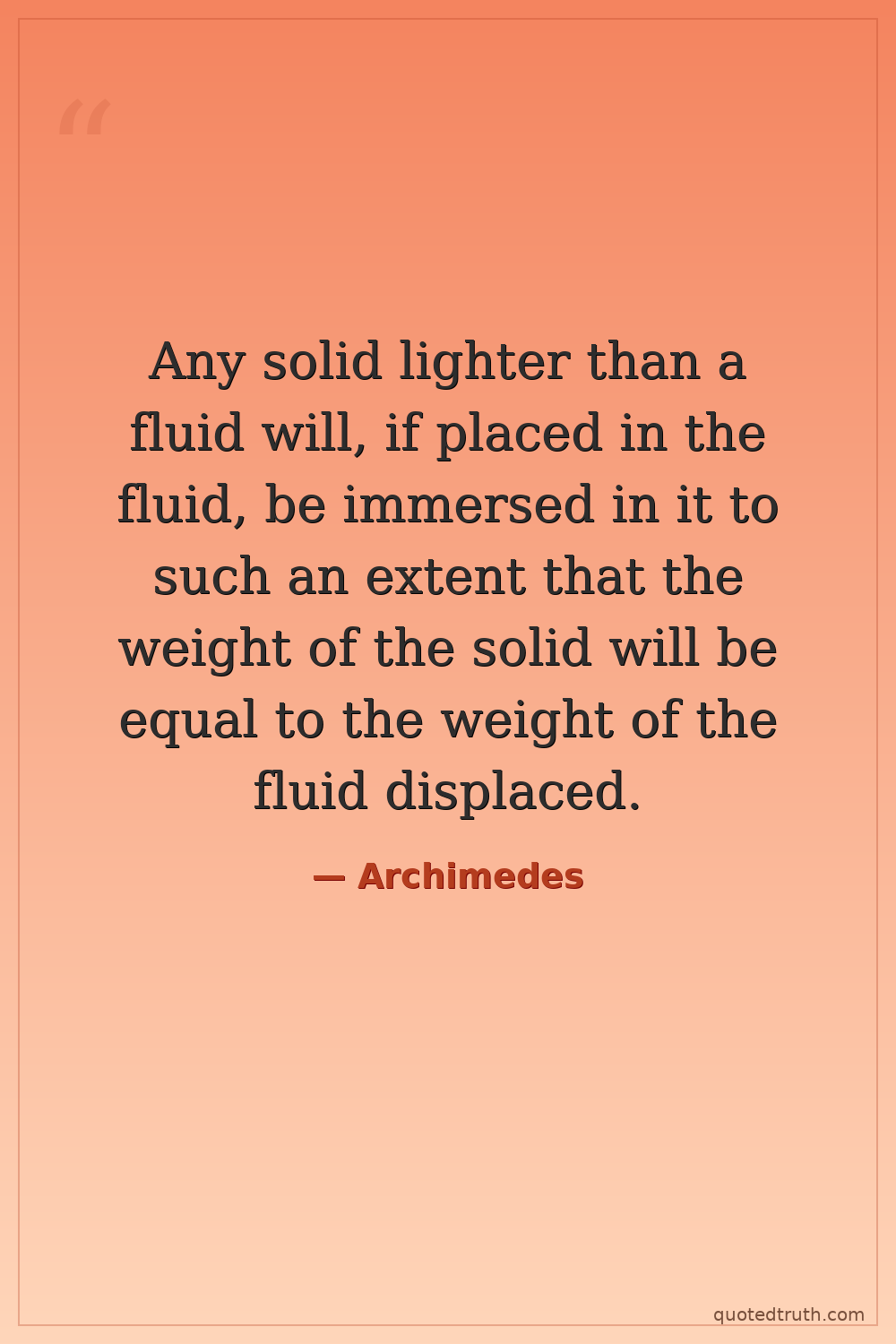
An object placed in liquid sinks only until the liquid it pushes aside weighs exactly as much as the object itself. Lighter objects float higher, heavier ones sink deeper, but the displaced fluid's weight always equals the floating object's weight. This is the precise mechanical law governing why ships float and balloons rise — a universal principle of buoyancy stated with mathematical exactness.
Relevance to Archimedes
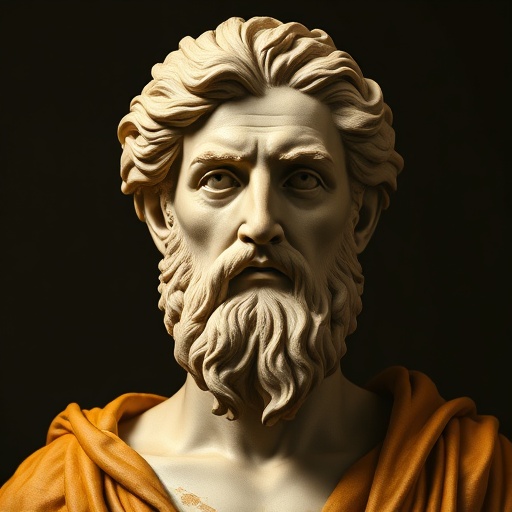
Archimedes discovered this principle, legend says, while stepping into a bath and noticing water overflow — famously shouting 'Eureka.' As Syracuse's foremost mathematician and engineer, he documented buoyancy rigorously in 'On Floating Bodies,' applying it to ship design and crown-density problems for King Hiero II. His career merged pure geometry with practical engineering, and this law exemplifies that fusion perfectly.
The era
In 3rd-century BCE Greece, Mediterranean naval power depended on understanding which ships would float under cargo loads. Syracuse was a major Sicilian city-state navigating Carthaginian and Roman pressures. Without calculus or modern physics, scholars relied on geometric reasoning. Archimedes formalized what sailors empirically knew, giving the ancient world its first rigorous hydrostatic law at a moment when naval engineering was strategically vital.
AI-generated insights based on extensive research and information for context. Factual errors? Email [email protected].