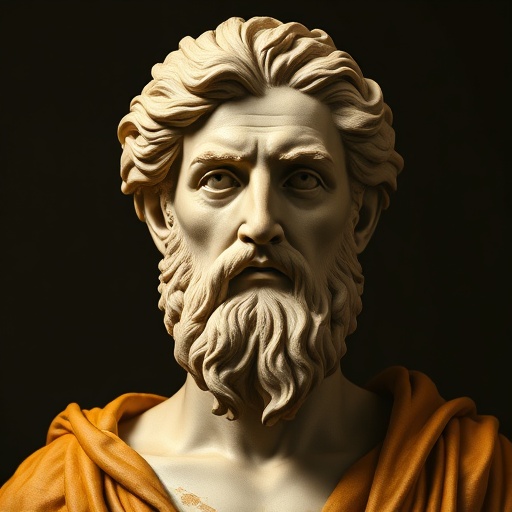
Archimedes — "It is a property of the circle that the ratio of its circumference to its diamet…"
It is a property of the circle that the ratio of its circumference to its diameter is the same for all circles.
It is a property of the circle that the ratio of its circumference to its diameter is the same for all circles.
Click any product to generate a realistic preview. Up to 3 at a time.
* Initial load can take up to 90 seconds — revising the preview in another color is nearly instant.
"The most important thing in life is to learn."
"Every solid body immersed in a fluid is buoyed up by a force equal to the weight of the fluid displaced by the body."
"The sun is a very large body, much larger than the Earth."
"The surface of any segment of a sphere is equal to a circle whose radius is the straight line drawn from the vertex of the segment to any point on the circumference of its base."
"There are some who think that the number of the sand is infinite in multitude."
Found in 1 providers: grok
1 source checked
No matter the size of a circle, dividing its circumference by its diameter always produces the same number — what we now call π (pi), approximately 3.14159. This was a radical insight: a single, universal constant governs every circle that exists. The relationship doesn't change whether the circle is the size of a coin or a planet. Archimedes is stating that geometry contains fixed, discoverable truths independent of human convention.
Archimedes (c. 287–212 BC) computed π by inscribing and circumscribing regular polygons inside and around circles, progressively narrowing its value to between 3 10/71 and 3 1/7 — remarkably close to the true value. His treatise Measurement of a Circle formalizes this exact observation. It reflects his rigorous, proof-driven approach: not accepting inherited approximations but deriving precise bounds through geometric reasoning. Math, for Archimedes, was about establishing eternal certainties.
In Archimedes' era, civilizations like Babylon and Egypt already used rough approximations of π for engineering, but none had proved its universality. Living in Hellenistic Syracuse during the 3rd century BC — an age dominated by Alexandrian scholarship — Archimedes operated in a culture that prized rigorous geometric proof over rule-of-thumb measurement. No symbolic notation for mathematical constants existed yet, making his verbal articulation of this universal ratio a genuinely foundational statement in the history of mathematics.
AI-generated insights based on extensive research and information for context. Factual errors? Email [email protected].
Your cart is empty