What it means
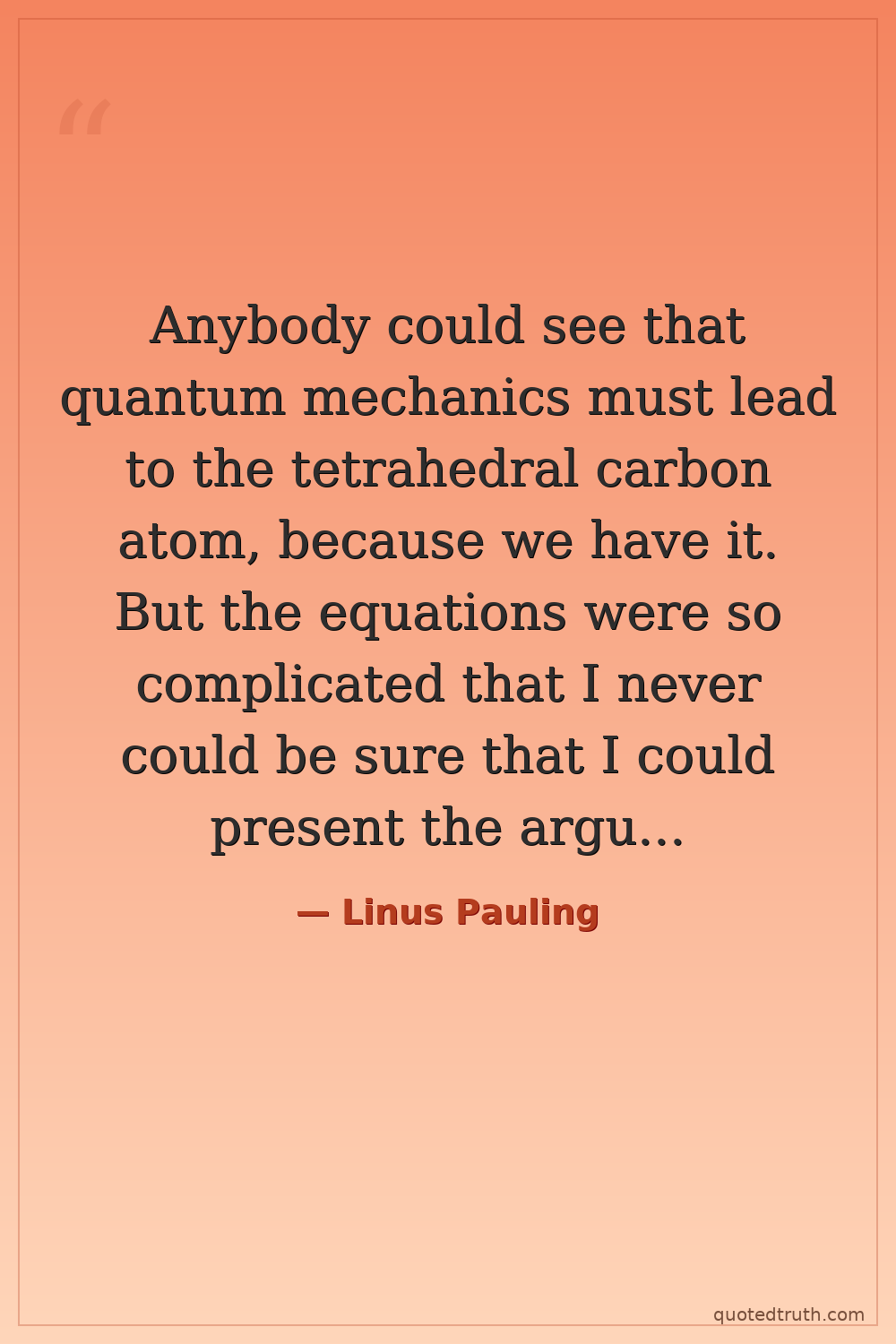
This quote captures the gap between knowing something is true and being able to prove it convincingly. Pauling knew quantum mechanics had to predict the tetrahedral shape of carbon's four bonds — we observe it in every organic molecule. But translating that certainty into airtight mathematical arguments was so formidably complex that he doubted his ability to persuade skeptics through equations alone. Observation outran formal proof.
Relevance to Linus Pauling
Pauling won the 1954 Nobel Prize in Chemistry for explaining chemical bonds using quantum mechanics, and hybridization theory — his concept — directly explains tetrahedral carbon via sp3 orbitals. His career bridged chemistry's intuitive structural tradition with rigorous quantum physics. This quote reveals his signature trait: fierce confidence in physical intuition combined with honest humility about mathematical communication, the tension that drove his most productive work.
The era
Quantum mechanics emerged in the mid-1920s — Schrödinger's equation (1926), Heisenberg's uncertainty principle (1927). Chemists scrambled to apply this new physics to molecular structure. Tetrahedral carbon had been accepted since van't Hoff's 1874 stereochemistry, but justifying it from quantum first principles meant solving notoriously intractable multi-electron equations. Pauling's era was chemistry and physics colliding for the first time, with mathematical rigor often lagging far behind physical intuition.
AI-generated insights based on extensive research and information for context. Factual errors? Email [email protected].