Linus Pauling — "The greatest enemy of knowledge is not ignorance, it is the illusion of knowledg…"
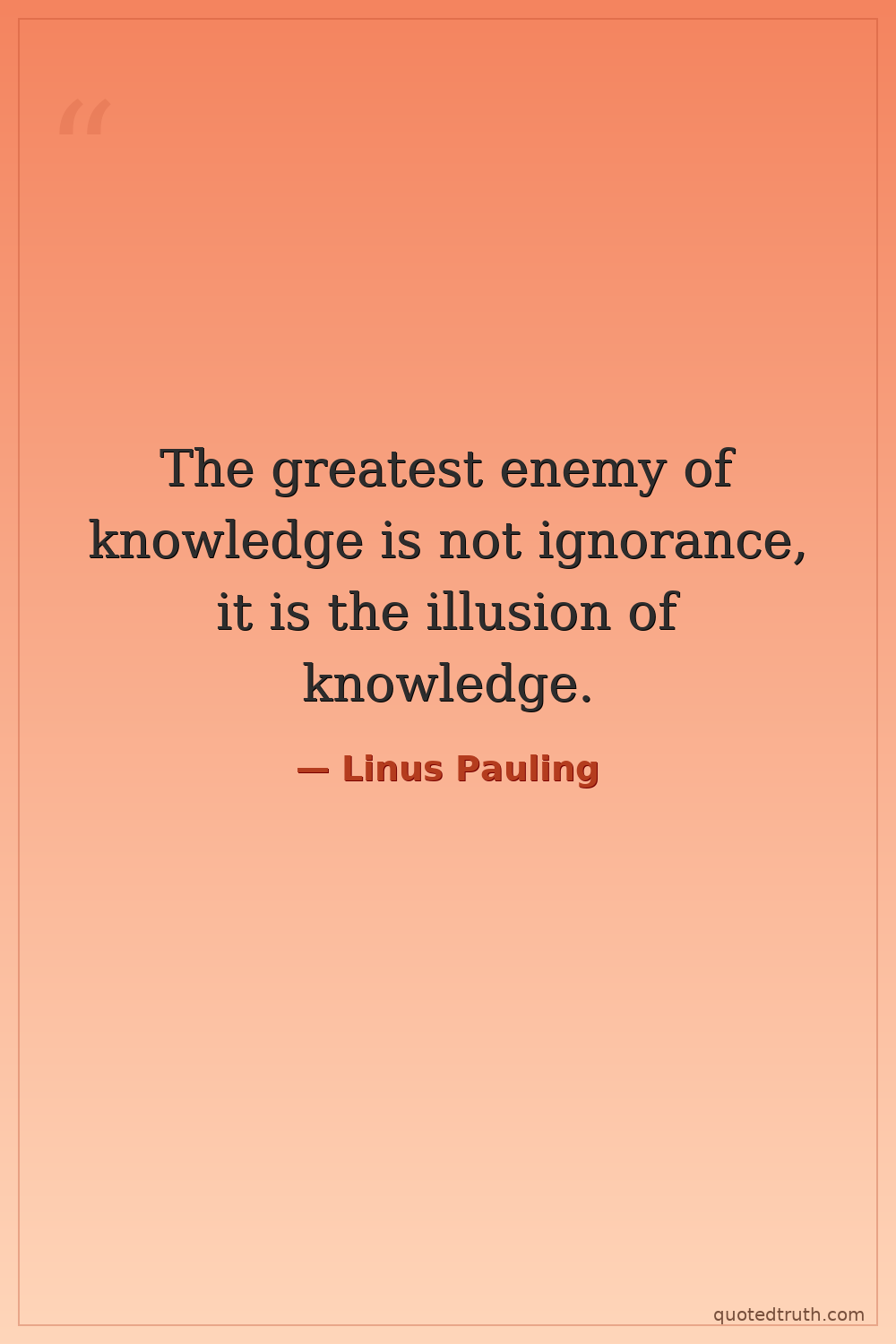
The greatest enemy of knowledge is not ignorance, it is the illusion of knowledge.
The greatest enemy of knowledge is not ignorance, it is the illusion of knowledge.
Click any product to generate a realistic preview. Up to 3 at a time.
* Initial load can take up to 90 seconds — revising the preview in another color is nearly instant.
"The greatest discovery of all time is that a person can change his future by merely changing his attitude."
"I am an optimist. I believe that the human race will solve its problems."
"I believe that every human being has the right to a healthy and happy life."
"I have always been a non-conformist."
"Life... is a relationship between molecules."
Found in 1 providers: grok
1 source checked
The real danger isn't not knowing something — it's believing you know it when you don't. False certainty shuts down curiosity and inquiry; you stop questioning because you assume the answer is settled. True ignorance at least leaves space for learning. But the illusion of knowledge creates a closed loop of confident wrong assumptions, making errors invisible and nearly impossible to correct.
Pauling earned two Nobel Prizes — Chemistry in 1954 for chemical bond theory, Peace in 1962 for nuclear disarmament advocacy — proving his capacity for rigorous, evidence-driven thinking. Yet his later insistence that megadose vitamin C prevented cancer, maintained despite clinical trials showing no benefit, illustrated the very trap this quote names. The same powerful intellect that revolutionized chemistry became locked in a conviction it could no longer question.
Pauling worked through mid-20th century science's most transformative decades — quantum mechanics, nuclear weapons, and molecular biology all emerged in rapid succession. Cold War anxieties meant scientific authority carried enormous public weight; experts were trusted implicitly, even when wrong. The atomic bomb debate and McCarthyism showed how institutional confidence could override genuine inquiry. In this climate, the gap between genuine expertise and confident assumption had measurable consequences for civilization.
AI-generated insights based on extensive research and information for context. Factual errors? Email [email protected].
Your cart is empty