What it means
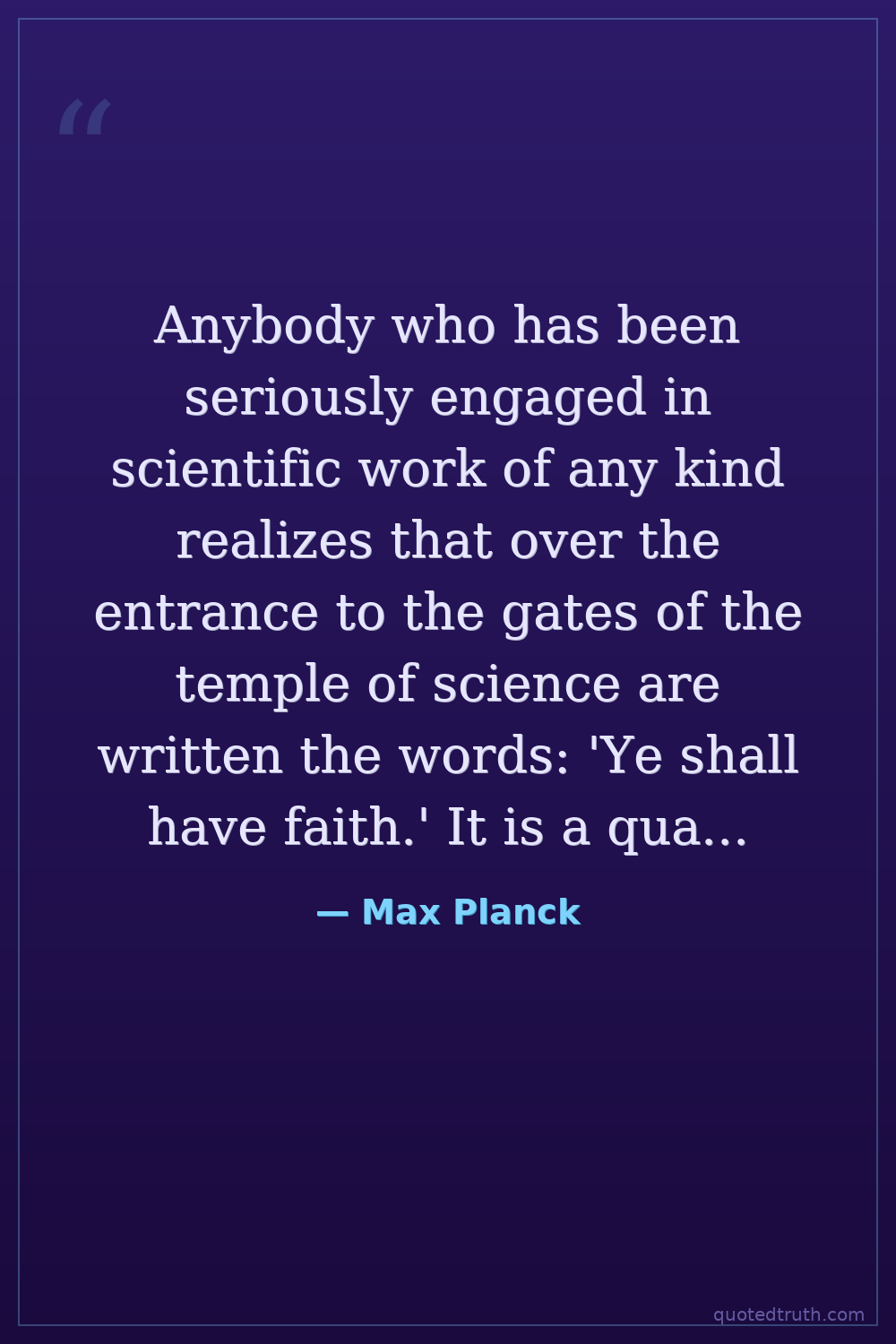
Planck argues that doing real scientific work requires faith—not religious faith, but deep trust that nature is orderly, that hidden truths can be uncovered, and that years of effort on unproven ideas will eventually pay off. Without this conviction, no one would persist through failed experiments, dead-end theories, or decades of uncertainty. Faith, in this sense, is the fuel that keeps scientists searching when evidence is still incomplete.
Relevance to Max Planck
Planck spent six years wrestling with blackbody radiation before reluctantly proposing energy quanta in 1900, an idea so radical he doubted it himself. A devout Lutheran who served as church elder, he openly rejected conflict between religion and science. His career demanded faith: he pursued thermodynamics when mentors called it a dead field, and championed Einstein's relativity when peers dismissed it. Persistence through doubt defined him.
The era
Planck's era (late 1800s to 1947) saw classical physics shattered by quantum mechanics and relativity, overturning certainties Newton had established. Scientists faced a universe that seemed irrational—wave-particle duality, uncertainty, curved spacetime. Meanwhile, positivism claimed science would replace religion, and post-WWI Germany plunged into nihilism. Planck, who lost two daughters in childbirth, a son in WWI, and another executed by Nazis in 1945, spoke to a generation desperately needing reasons to keep believing anything.
AI-generated insights based on extensive research and information for context. Factual errors? Email [email protected].