What it means
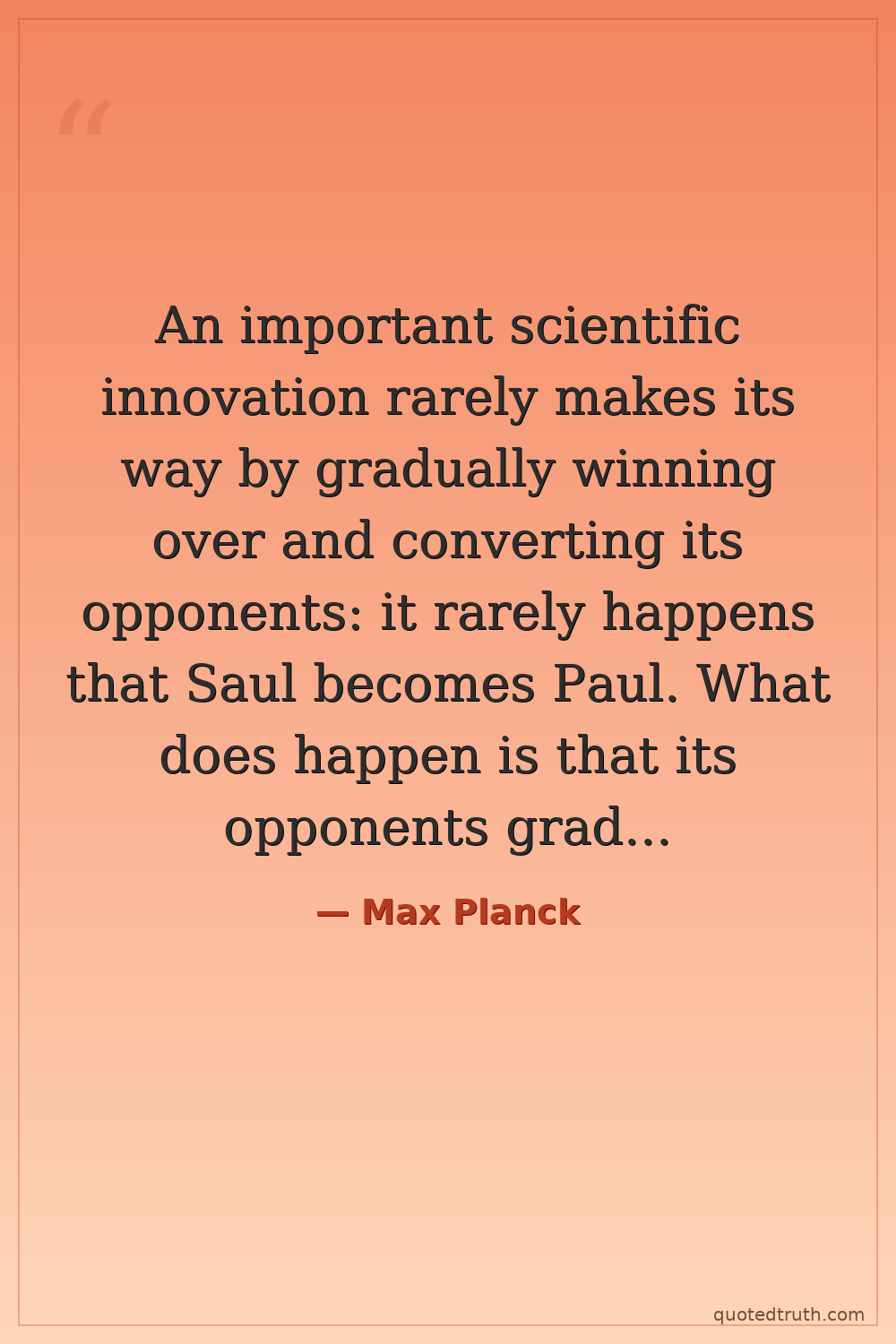
New scientific ideas rarely succeed by persuading established experts to change their minds. Instead, progress happens generationally: older scientists committed to the old framework simply pass away, while younger scientists who encounter the new ideas during their training accept them as normal. Truth doesn't win arguments; it wins funerals. Intellectual revolutions advance one obituary at a time, not through debate or conversion of entrenched opponents.
Relevance to Max Planck
Planck lived this firsthand. When he introduced energy quantization in 1900, senior physicists dismissed it, and Planck himself hesitated about its implications for years. He watched younger physicists like Einstein, Bohr, and Heisenberg embrace quantum mechanics while his own generation resisted. Having spent decades defending radical ideas against classical-physics orthodoxy, he distilled this bitter observation about scientific sociology from personal experience navigating the quantum revolution he reluctantly started.
The era
Planck wrote this in his 1948 Scientific Autobiography, reflecting on physics's upheaval from 1900-1930. Quantum mechanics and relativity had overturned Newtonian certainties, splitting physics into warring camps. Einstein himself resisted quantum indeterminacy. Meanwhile, Nazi Germany had purged Jewish physicists, killed Planck's son for resisting Hitler, and shattered the scientific community. Planck witnessed both intellectual and political orthodoxies crumble only as their defenders died, validating his generational theory of change.
AI-generated insights based on extensive research and information for context. Factual errors? Email [email protected].