What it means
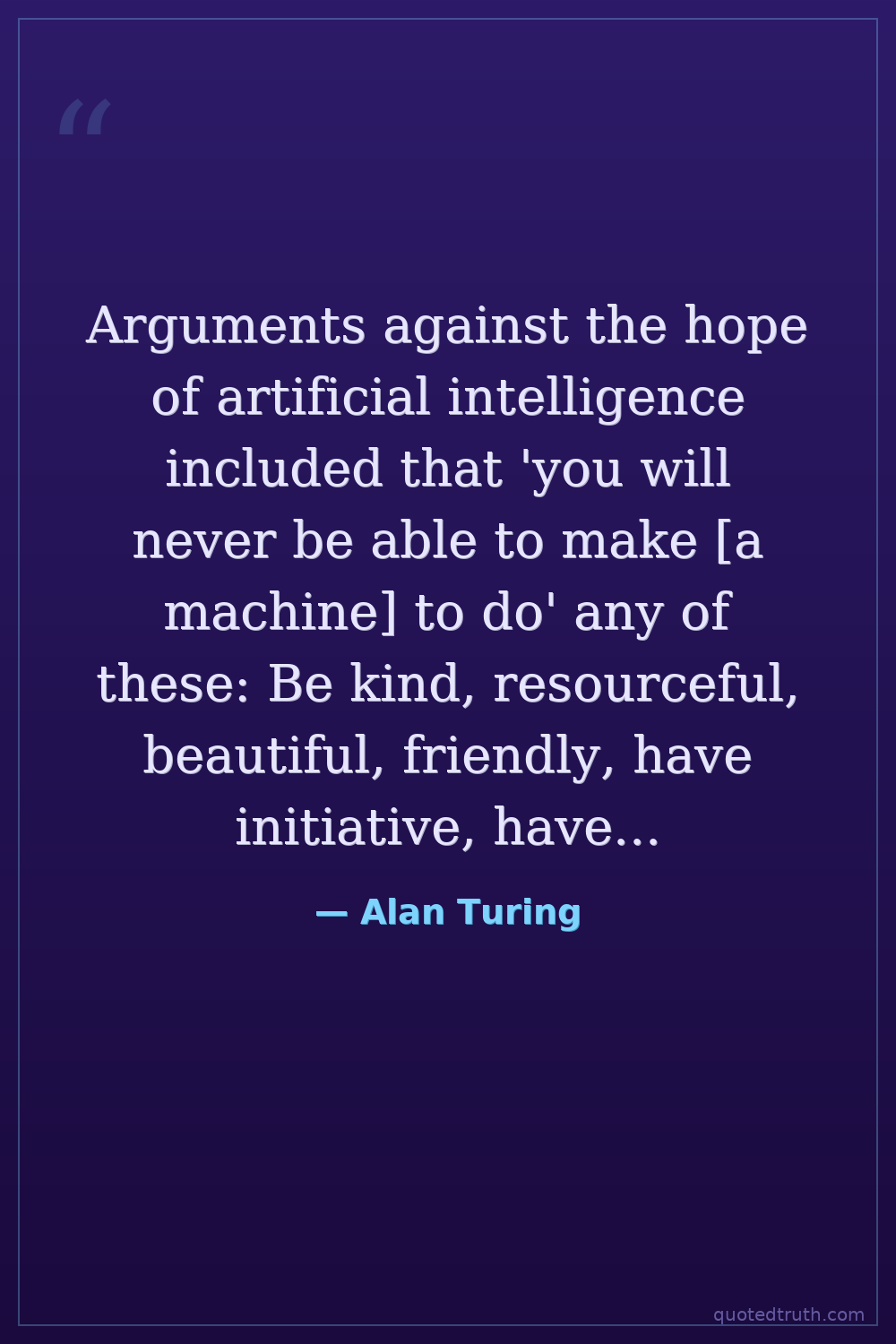
Turing catalogued skeptics' claims about what machines could never do — from kindness and humor to falling in love and making mistakes. By listing these supposed impossibilities together, he invited readers to interrogate each one: is kindness truly uncomputable? Is making mistakes? The cumulative effect is subversive — the more qualities you enumerate, the more you reveal that most reduce to patterns a sufficiently complex system might one day replicate.
Relevance to Alan Turing
Turing personally embodied items on this list. Prosecuted in 1952 for homosexuality and subjected to chemical castration, the phrase 'fall in love' carries direct biographical weight — the British state criminalized him for exactly that. A codebreaker who built machines to outsmart machines, he had firsthand evidence computation could mimic reasoning, yet lived as a man the state treated as less than fully human while being arguably the world's greatest living mind.
The era
Written in 1950 as the first electronic computers became operational, Western culture still held that human qualities were divinely singular. Cold War anxieties sharpened the human-versus-machine question: automation threatened labor, and nuclear arsenals made mechanized decision-making existentially dangerous. Religious and secular thinkers alike resisted reducing the soul to mechanism. Turing's list forced 1950s readers — clergy, engineers, philosophers — to define precisely what humanity meant before dismissing the machine.
AI-generated insights based on extensive research and information for context. Factual errors? Email [email protected].