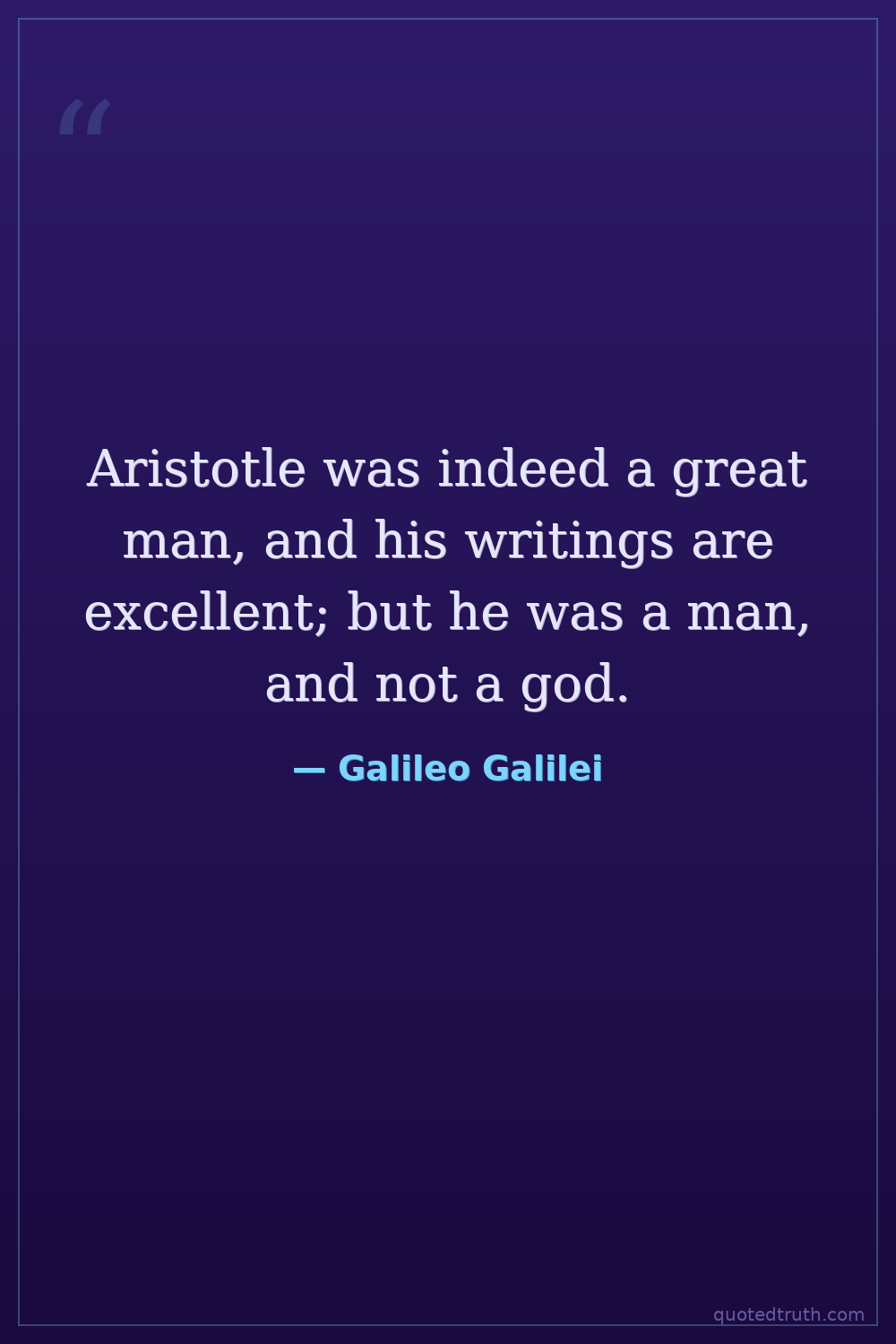
Galileo Galilei — "Aristotle was indeed a great man, and his writings are excellent; but he was a m…"
Aristotle was indeed a great man, and his writings are excellent; but he was a man, and not a god.
Aristotle was indeed a great man, and his writings are excellent; but he was a man, and not a god.
Click any product to generate a realistic preview. Up to 3 at a time.
* Initial load can take up to 90 seconds — revising the preview in another color is nearly instant.
"The universe is an immense, an incomparable, and an inexhaustible library."
"With the telescope, I have discovered many things that contradict the ideas of ancient philosophers."
"The purpose of science is not to open the door to infinite wisdom, but to set a limit to infinite error."
"The two books from which I draw my knowledge are the book of the created world and the book of the Holy Scripture."
"The sun, with all those planets revolving around it and dependent on it, can still ripen a bunch of grapes as if it had nothing else in the universe to do."
Found in 1 providers: grok
1 source checked
No matter how brilliant or respected a thinker is, their authority comes from evidence and reason, not from being infallible. Even the greatest intellectual giants can be wrong. We should judge ideas by whether they hold up under scrutiny, not by the reputation of whoever proposed them. Reverence for a name is not a substitute for truth.
Galileo spent his career challenging Aristotelian physics and cosmology, demonstrating through telescopic observation that celestial bodies were not perfect spheres and that Earth was not the center of the universe. Church and university authorities wielded Aristotle's texts as sacred doctrine. Galileo's entire scientific project required dismantling that unquestioned deference to ancient authority.
In the early modern period, Aristotle's natural philosophy had been absorbed into Catholic theology by Aquinas, making it nearly heretical to contradict him. Universities taught Aristotelian physics as settled truth. The Scientific Revolution was fundamentally a battle to replace inherited textual authority with empirical observation, and Galileo stood at the center of that dangerous intellectual conflict.
AI-generated insights based on extensive research and information for context. Factual errors? Email [email protected].
Your cart is empty