Galileo Galilei — "The purpose of science is not to open the door to infinite wisdom, but to set a …"
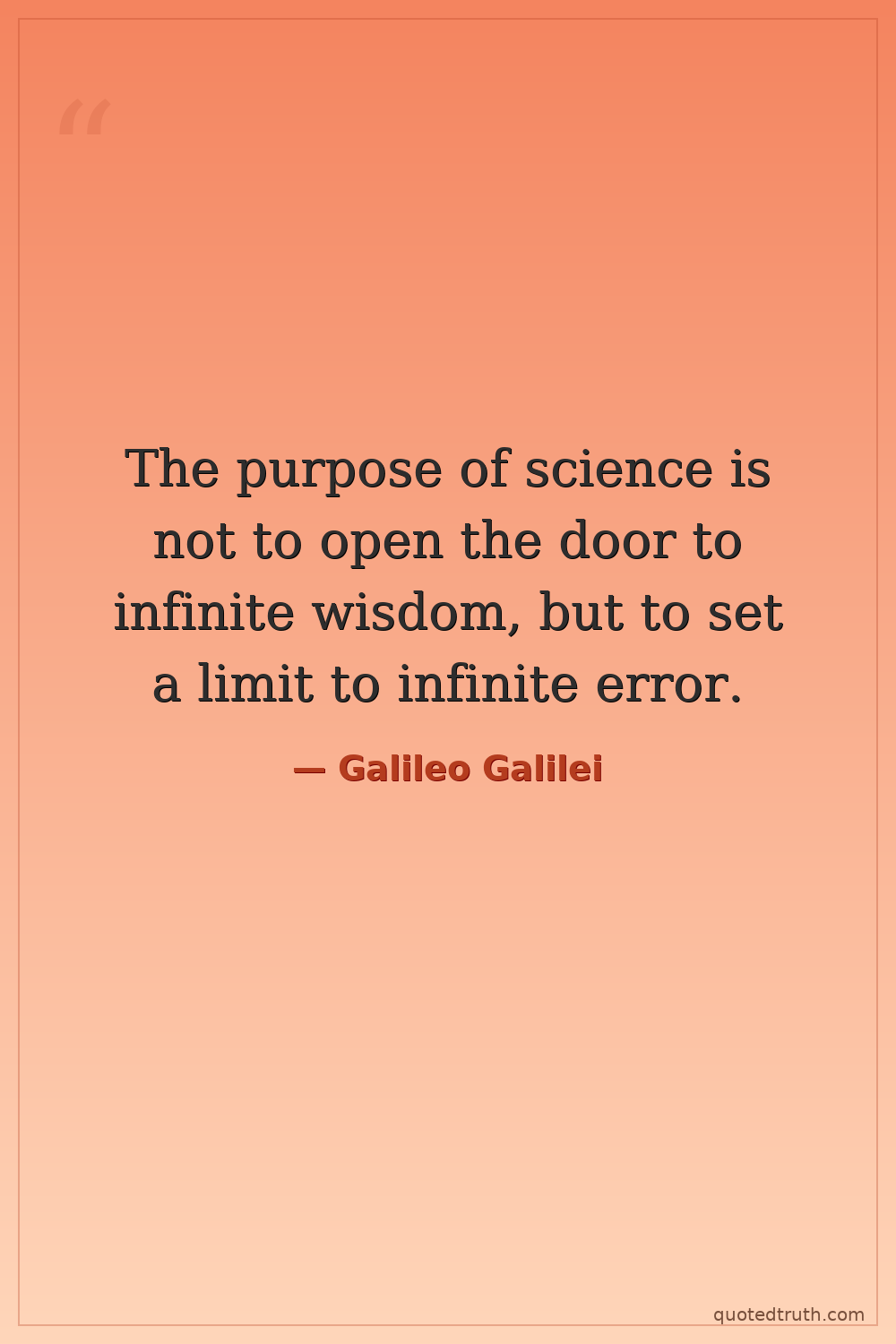
The purpose of science is not to open the door to infinite wisdom, but to set a limit to infinite error.
The purpose of science is not to open the door to infinite wisdom, but to set a limit to infinite error.
Click any product to generate a realistic preview. Up to 3 at a time.
* Initial load can take up to 90 seconds — revising the preview in another color is nearly instant.
"I have written up many reasons and refutations on the subject, but I have not dared until now to bring them into the open, being warned by the fortunes of Copernicus himself, our master, who procured …"
"The greatest wisdom consists in knowing what is truly useful."
"I know that I am mortal, and that my life will pass away like a shadow; but I hope that my discoveries will live on."
"It is necessary to examine the actual structure of the universe, and not to cling to old ideas."
"By denying scientific principles, one may maintain any paradox."
Often attributed, though the precise wording and source are debated. Captures his scientific ethos.
Date: c. 1600s
GeneralFound in 1 providers: grok
1 source checked
Science's job is not to reveal all truth, but to eliminate wrong answers. Knowledge advances by ruling out falsehoods, not by reaching some final complete understanding. Progress means fewer errors, not total enlightenment. This is a humble, practical view of what inquiry actually accomplishes — controlled reduction of ignorance rather than the impossible achievement of perfect, unlimited wisdom.
Galileo spent his career correcting errors embedded in Aristotelian physics and Ptolemaic astronomy. His telescopic observations didn't claim omniscience — they demolished specific false claims: that celestial bodies were perfect spheres, that Earth sat motionless at the universe's center. His trial by the Inquisition showed him firsthand how institutions resist error-correction. His methodology was fundamentally about falsification and evidence over authority.
The early modern period saw the Scientific Revolution challenging a millennium of received scholastic wisdom. The Catholic Church held intellectual authority, and classical texts were treated as infallible. Challenging Aristotle or Ptolemy wasn't merely academic heresy — it carried real danger. In this climate, framing science as error-limiting rather than God-rivaling wisdom-claiming was both intellectually honest and strategically prudent.
AI-generated insights based on extensive research and information for context. Factual errors? Email [email protected].
Your cart is empty