What it means
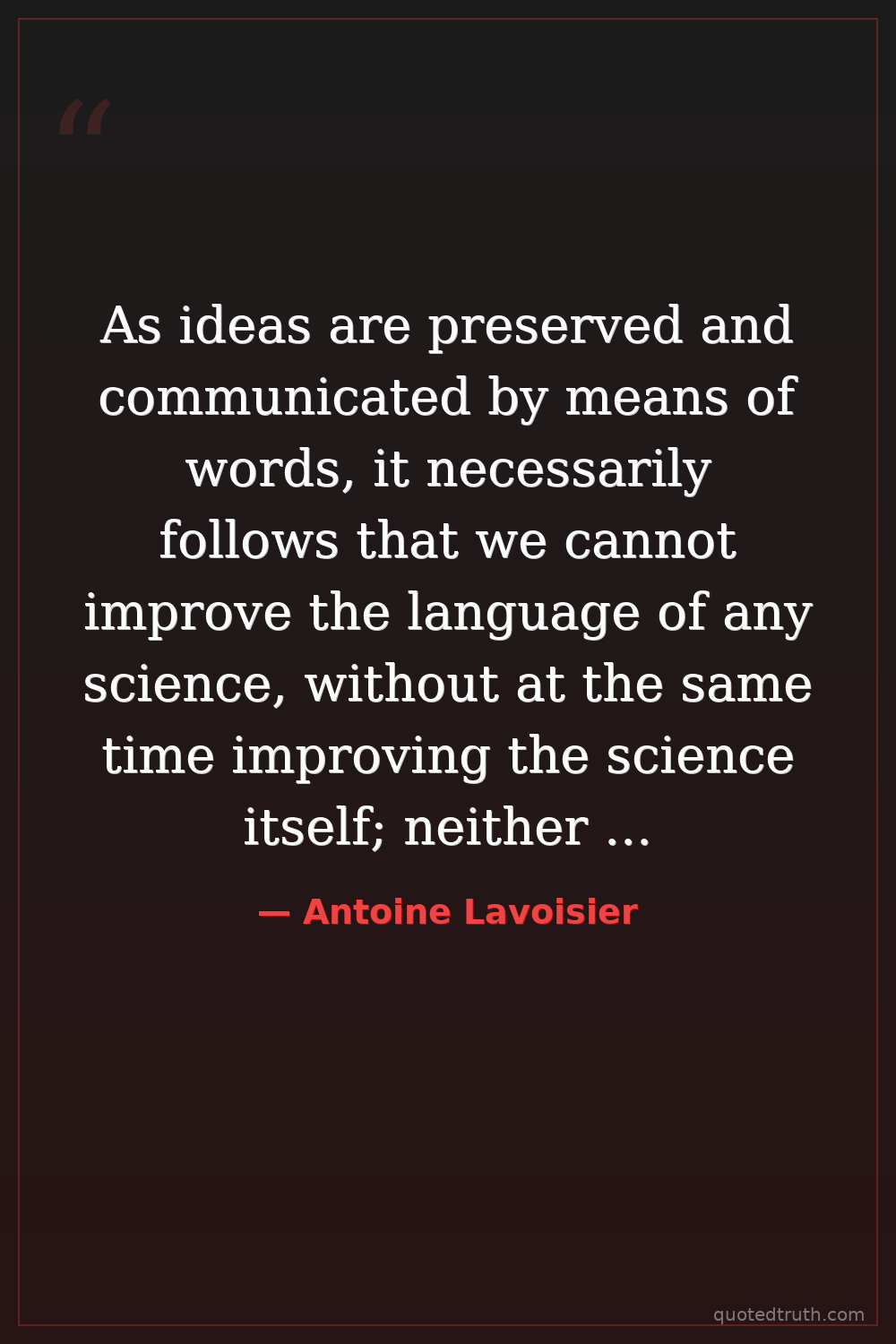
Scientific knowledge and the words used to describe it are inseparable. You can't refine a field of study without also refining its vocabulary, and you can't clean up terminology without sharpening the underlying concepts. Precise language produces precise thinking, while sloppy or outdated terms carry hidden errors into every new discovery. Progress in understanding and progress in how we name things happen together, feeding back into each other continuously.
Relevance to Antoine Lavoisier
Lavoisier literally rewrote chemistry's vocabulary. In his 1787 Méthode de nomenclature chimique, he replaced alchemical names like 'oil of vitriol' with systematic terms like 'sulfuric acid,' and coined 'oxygen' and 'hydrogen.' His quantitative experiments overturned phlogiston theory and established conservation of mass. For him, the linguistic overhaul and the scientific revolution were the same project, which is exactly what this quote argues.
The era
In the late 1700s, chemistry was transitioning from alchemy to a rigorous science. Terminology was inconsistent, mystical, and rooted in medieval traditions, making communication across Europe chaotic. The Enlightenment demanded rational systems, and French intellectuals were systematizing knowledge through encyclopedias and standardized weights and measures. Lavoisier published his Traité élémentaire in 1789, the same year the French Revolution began, in a climate that prized reason, classification, and overthrowing inherited authority, intellectual or political.
AI-generated insights based on extensive research and information for context. Factual errors? Email [email protected].