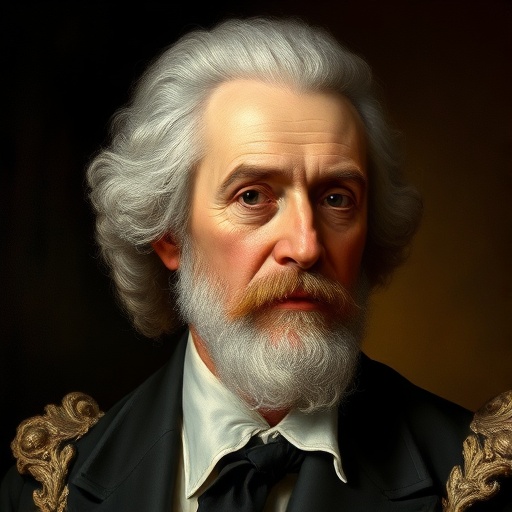
Antoine Lavoisier — "I have no other ambition than to serve humanity."
I have no other ambition than to serve humanity.
I have no other ambition than to serve humanity.
Click any product to generate a realistic preview. Up to 3 at a time.
* Initial load can take up to 90 seconds — revising the preview in another color is nearly instant.
"I have always found that the more I learned, the more I realized how much I did not know."
"The greatest obstacle to discovery is not ignorance, but the illusion of knowledge."
"I have endeavored to make chemistry a science of reasoning, and not of memory."
"Nothing is created, either in the operations of art, or in those of nature; and it may be considered as a general principle that in every operation there exists an equal quantity of matter before and …"
"The value of a discovery consists not in its novelty, but in its truth."
Found in 1 providers: grok
1 source checked
The quote expresses a commitment to placing collective human welfare above personal achievement. Rather than pursuing science for fame, wealth, or intellectual pride alone, it frames ambition as inherently outward-facing — measured by what it contributes to others. In modern terms: your work matters not because of the recognition it earns you, but because of the real-world problems it solves or the lives it improves.
Lavoisier dismantled centuries of flawed chemistry — overturning phlogiston theory, naming oxygen and hydrogen, establishing conservation of mass — not for profit but at personal expense, funding experiments from his own fortune. He simultaneously worked to improve French gunpowder, agricultural yields, and public health policy. Executed during the Revolution's Reign of Terror in 1794, his final years proved this wasn't rhetoric: he sacrificed his life in service to France and science.
The Enlightenment's central conviction held that reason and science existed to elevate humanity, not merely satisfy curiosity. In 18th-century France, philosophes like Voltaire and Diderot championed knowledge as a public good. Scientific academies were state-funded specifically to solve practical problems — agriculture, navigation, medicine. Lavoisier's era also saw rising tension between aristocratic privilege and civic duty, making declarations of service to humanity politically charged as well as philosophically significant.
AI-generated insights based on extensive research and information for context. Factual errors? Email [email protected].
Your cart is empty