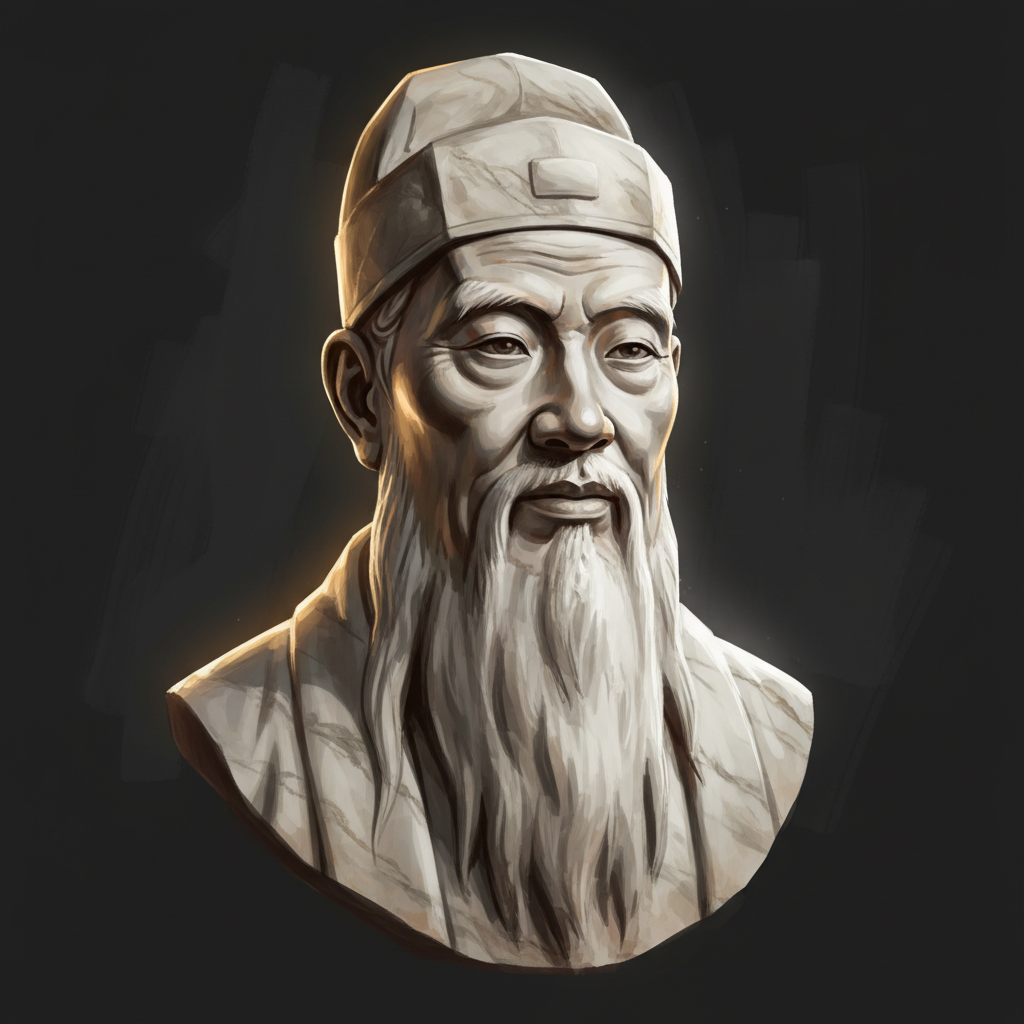
Confucius — "Be strict with yourself but least reproachful of others and complaint is kept af…"
Be strict with yourself but least reproachful of others and complaint is kept afar.
Be strict with yourself but least reproachful of others and complaint is kept afar.
Click any product to generate a realistic preview. Up to 3 at a time.
* Initial load can take up to 90 seconds — revising the preview in another color is nearly instant.
"The superior man is dignified but does not wrangle."
"The scholar who cherishes the love of comfort is not fit to be deemed a scholar."
"The man who asks a question is a fool for a minute, the man who does not ask is a fool for life."
"If a man does not say to himself, 'What shall I think of this? What shall I think of this?' I can make nothing of him."
"The superior man is satisfied with himself; the inferior man seeks to please others."
Chinese philosopher and teacher whose teachings (compiled by his students in the Analects) became the foundational ethical framework of East Asian civilization for 2,500 years. Closely associated with Mencius (his most-influential follower a century later). For an intellectual contrast, see Laozi, near-contemporary Chinese sage and Tao Te Ching author — Confucius systematized social order through ritual and family hierarchy; Laozi's Taoist effortless-action philosophy argued such systems were the disease, not the cure. The two founding poles of Chinese moral philosophy — every East Asian moral tradition since has positioned itself between them.
The standard scholarly entry points to Confucius's work: Philip J. Ivanhoe (Georgetown, Chinese philosophy) — Confucian Moral Self Cultivation (2000); Edward Slingerland (UBC, Asian Studies) — Effortless Action: Wu-wei as Conceptual Metaphor (2003); Tu Weiming (Harvard, Confucian scholar) — Confucian Thought: Selfhood as Creative Transformation (1985). These are the works graduate seminars cite when teaching Confucius.
From a teaching on self-discipline and judgment of others
Date: c. 551-479 BCE
PhilosophicalFound in 1 providers: gemini
1 source checked
Hold yourself to high standards while being gentle and forgiving when judging others. When you focus on your own faults rather than cataloging everyone else's shortcomings, resentment and grievance naturally fade. You stop blaming people around you because you're busy improving yourself, and the bitterness that fuels constant complaining loses its foothold in your daily life and relationships.
Confucius built his teaching around self-cultivation (xiushen) as the root of social harmony, insisting a gentleman examines himself daily. As a teacher who traveled between warring states seeking rulers who would listen, he met constant rejection yet blamed circumstances rather than men. His Analects repeatedly contrast the junzi, who demands much of himself, with the petty person, who demands much of others.
Confucius lived during the late Spring and Autumn period (551-479 BCE), when Zhou dynasty authority had collapsed and rival states waged endless war. Nobles blamed each other for chaos, courts festered with intrigue, and ritual propriety was decaying. Confucius argued that political order could only be rebuilt from personal moral reform upward, making inward accountability rather than outward blame a radical prescription for a complaint-saturated, finger-pointing aristocratic culture.
AI-generated insights based on extensive research and information for context. Factual errors? Email [email protected].
Your cart is empty