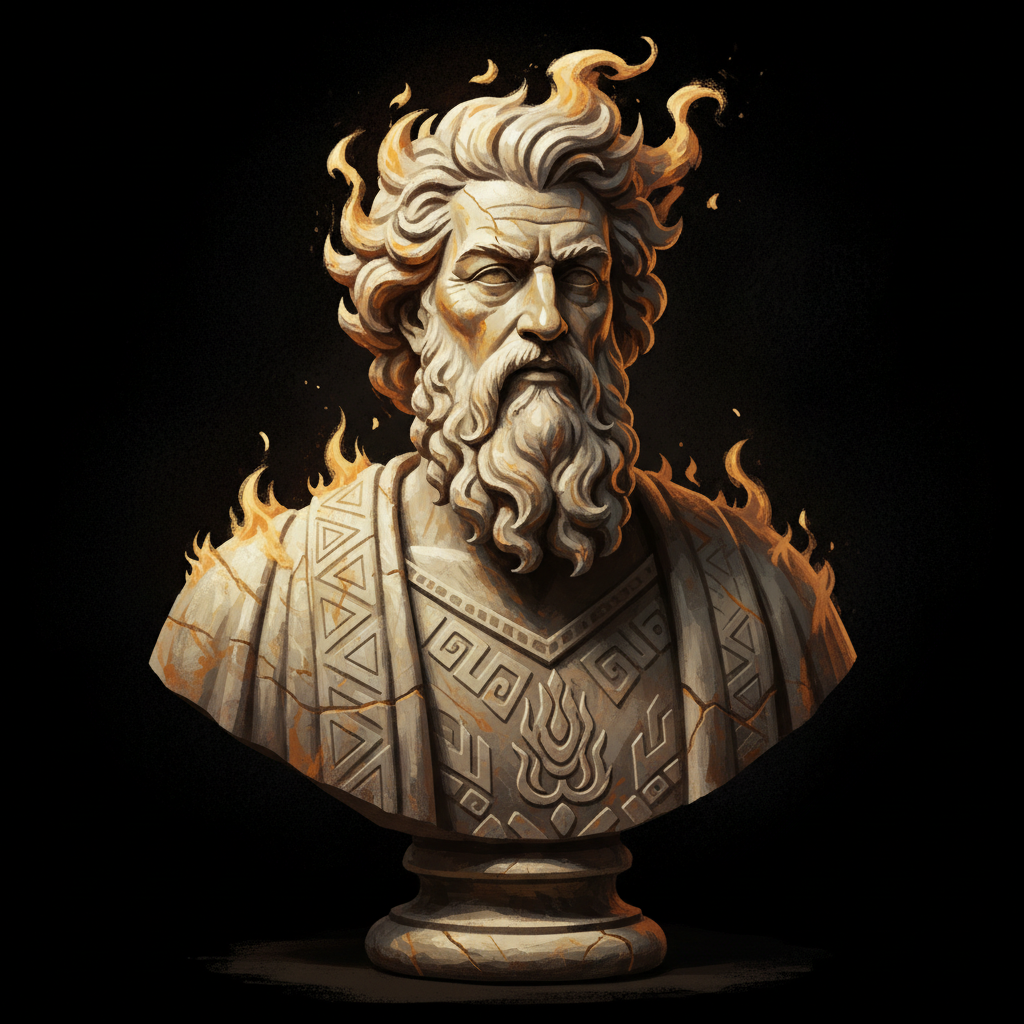
Zoroaster — "Between these two, the demons have not chosen aright, for delusion came upon the…"
Between these two, the demons have not chosen aright, for delusion came upon them as they consulted, so that they chose the worst thought.
Between these two, the demons have not chosen aright, for delusion came upon them as they consulted, so that they chose the worst thought.
Click any product to generate a realistic preview. Up to 3 at a time.
* Initial load can take up to 90 seconds — revising the preview in another color is nearly instant.
"Always meet petulance with gentleness and perverseness with kindness. A gentle hand can lead even an elephant by a hair. Reply to thine enemy with gentleness."
"One good deed is worth a thousand prayers."
"Through righteous living, we can hasten the coming of the Frashokereti (renovation of the world)."
"The one who is false is a follower of the Lie; the one who is true is a follower of Truth."
"I who have set my heart on watching over the soul, in union with Good Thought, as I praise and proclaim you, O Wise Lord."
Iranian prophet who founded Zoroastrianism, the first major religion of cosmic dualism between good (Ahura Mazda) and evil (Angra Mainyu). Closely associated with The Buddha (near-contemporary Eastern moral-cosmological revolutionary). For an intellectual contrast, see Friedrich Nietzsche, German philosopher of 'beyond good and evil' — Nietzsche appropriated Zarathustra's name for Thus Spoke Zarathustra (1883) precisely to invert the original's moral cosmology — the historical Zoroaster founded the good-versus-evil framework Nietzsche's character announces the end of.
Found in 1 providers: grok
1 source checked
When faced with a choice between good and evil, the demons picked wrong because confusion clouded their judgment during deliberation. Rather than reasoning clearly, they fell for deception and ended up embracing the harmful option. The point is that bad choices often come not from pure malice but from muddled thinking, self-deception, and failing to weigh options honestly before committing to a path.
Zoroaster framed existence as a moral contest between Spenta Mainyu (the good spirit) and Angra Mainyu (the destructive spirit), with every being required to choose. As a priest-prophet who broke from traditional Iranian polytheism, he taught that daevas, once worshipped as gods, were demons who had freely chosen the Lie. This verse, from his own Gathas, encapsulates his signature doctrine of moral dualism and personal ethical agency.
Zoroaster lived in Bronze Age eastern Iran, roughly 1500–1000 BCE, amid polytheistic tribal religions demanding blood sacrifice and warrior-cult devotion to daevas. Society was shifting from nomadic herding toward settled agriculture, creating tension between raiders and farmers. Into this, Zoroaster introduced a radical monotheistic ethics centered on Ahura Mazda, free will, and the cosmic battle between truth (asha) and lie (druj), reframing old gods as demons who chose wrongly.
AI-generated insights based on extensive research and information for context. Factual errors? Email [email protected].
Your cart is empty