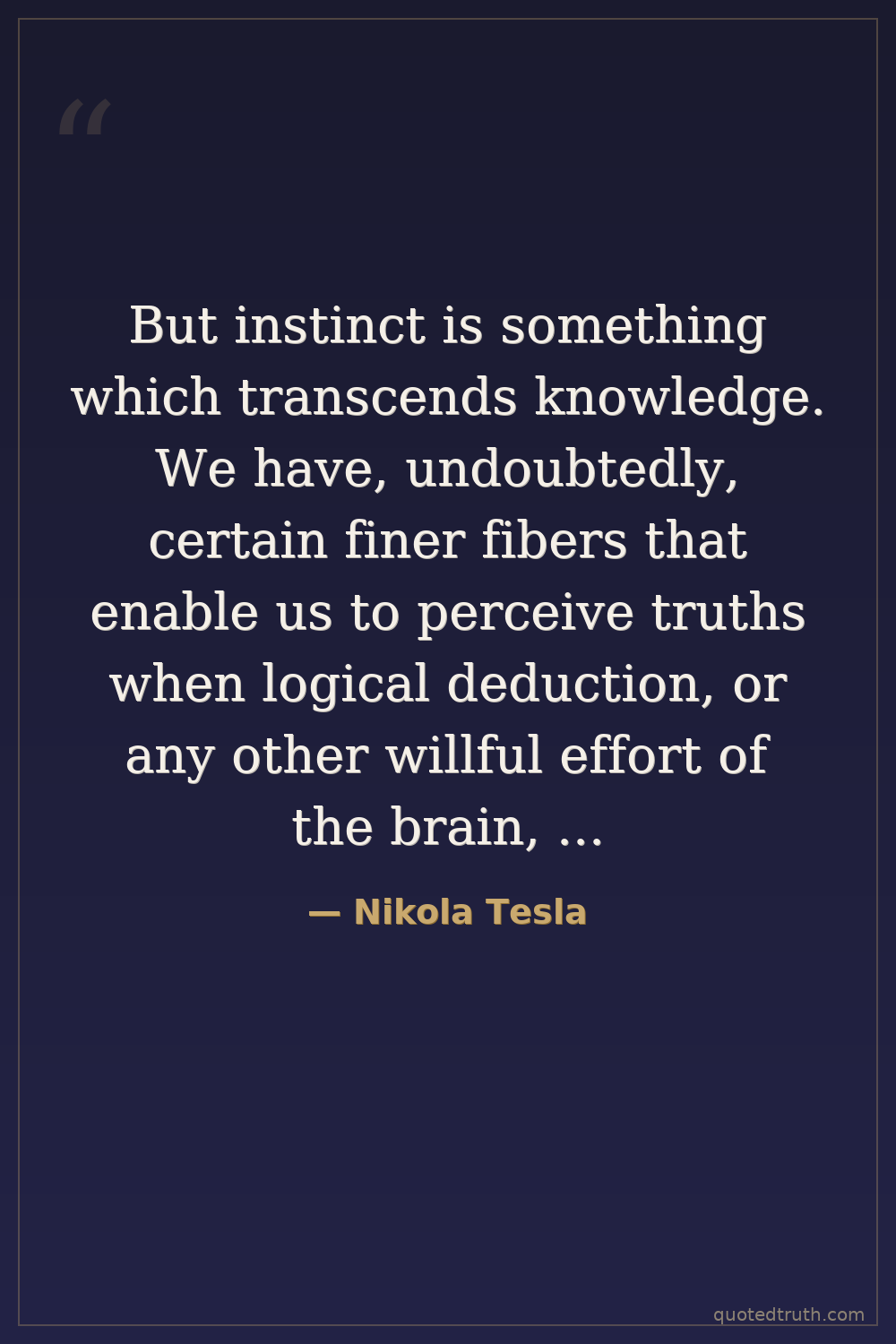
Nikola Tesla — "But instinct is something which transcends knowledge. We have, undoubtedly, cert…"

But instinct is something which transcends knowledge. We have, undoubtedly, certain finer fibers that enable us to perceive truths when logical deduction, or any other willful effort of the brain, is futile.
Nikola Tesla — Nikola Tesla Modern · AC electrical system, inventor

Get This Quote & Author's Image Illustrated On:

Click any product to generate a realistic preview. Up to 3 at a time.
* Initial load can take up to 90 seconds — revising the preview in another color is nearly instant.

Kitchen

Apparel

Other

About Nikola Tesla (1856-1943)

Serbian-American inventor and electrical engineer whose alternating-current designs powered the modern electrical grid; died poor and largely forgotten. Closely associated with George Westinghouse (his AC-power business partner) and Mihajlo Pupin (fellow Serbian-American physicist at Columbia). For an intellectual contrast, see Thomas Edison, American inventor and direct-current advocate — Edison's direct-current power-distribution scheme was displaced by Tesla-Westinghouse AC in the 1890s 'War of Currents'. Edison ran a public-relations campaign electrocuting animals to discredit AC — the most famous engineering-ethics rivalry in American history. Tesla's AC won and powers nearly every electrical grid on Earth.

Details

Deep, philosophical reflection on intuition and higher forms of perception beyond logic.

Date: Approximate

Philosophical

Verification

Unverifiable

Found in 1 providers: gemini

1 source checked

Understanding this quote

What it means

Some truths arrive before reasoning does. Beyond logic and deliberate thought, humans possess a subtler perceptive faculty — call it intuition, instinct, or gut feeling — that grasps reality when systematic analysis fails. This capacity operates beneath conscious effort, accessing insights that careful step-by-step reasoning cannot reach, suggesting the mind works on multiple levels simultaneously, only one of which is deliberate.

Relevance to Nikola Tesla

Tesla worked in a domain demanding rigorous mathematics yet repeatedly credited sudden flashes of vision for his greatest breakthroughs. He famously conceived the rotating magnetic field principle in a moment of inspiration while walking in Budapest. He distrusted Edison's purely empirical trial-and-error approach, preferring mental visualization — an internal, non-logical process — before building anything, embodying exactly the instinct-over-deduction philosophy he describes.

The era

Tesla wrote during the late 19th and early 20th centuries, when scientific rationalism and positivism dominated intellectual culture. Thinkers like Auguste Comte insisted only measurable, logical knowledge was valid. Simultaneously, Freud was mapping the unconscious mind, and Bergson was philosophizing about intuition versus intellect. Tesla's claim for instinct as a legitimate cognitive tool was quietly countercultural, pushing back against pure mechanistic rationalism at its peak.

AI-generated insights based on extensive research and information for context. Factual errors? Email [email protected].
Your Cart

Your cart is empty