Nikola Tesla — "I myself have made my own discoveries in the greatest solitude, and when I have …"
I myself have made my own discoveries in the greatest solitude, and when I have been alone, undisturbed.
I myself have made my own discoveries in the greatest solitude, and when I have been alone, undisturbed.
Click any product to generate a realistic preview. Up to 3 at a time.
* Initial load can take up to 90 seconds — revising the preview in another color is nearly instant.
"I am equally proud of my Serbian origin and my Croatian homeland."
"I have harnessed the cosmic rays and caused them to operate a motive device."
"I felt that I could not touch the hair of other people, except with gloves."
"We crave for new sensations but soon become indifferent to them. The wonders of yesterday are today common occurrences."
"The year 2100 will see eugenics universally established. In past ages, the law governing the survival of the fittest roughly weeded out the less desirable strains. Then man's new sense of pity began t…"
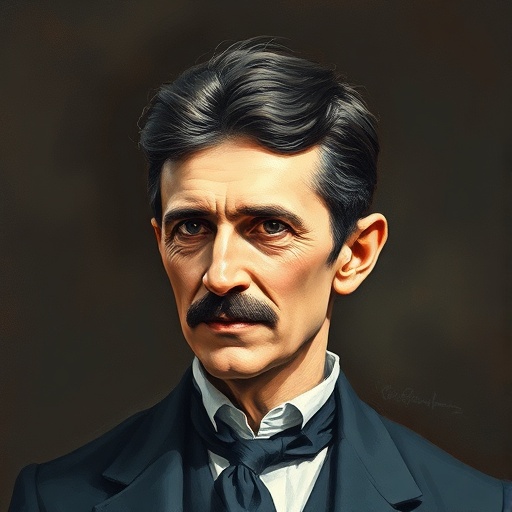
Serbian-American inventor and electrical engineer whose alternating-current designs powered the modern electrical grid; died poor and largely forgotten. Closely associated with George Westinghouse (his AC-power business partner) and Mihajlo Pupin (fellow Serbian-American physicist at Columbia). For an intellectual contrast, see Thomas Edison, American inventor and direct-current advocate — Edison's direct-current power-distribution scheme was displaced by Tesla-Westinghouse AC in the 1890s 'War of Currents'. Edison ran a public-relations campaign electrocuting animals to discredit AC — the most famous engineering-ethics rivalry in American history. Tesla's AC won and powers nearly every electrical grid on Earth.
Interview with Arthur Brisbane, 'When Woman Is Boss' (published in various newspapers)
Date: 1929
GeneralFound in 1 providers: grok
1 source checked
True creative breakthroughs often emerge from deep solitude, free from distraction and social noise. When the mind is undisturbed, it can pursue ideas with full concentration. The speaker asserts that isolation isn't a weakness but a condition for original discovery—that the most significant insights come not from collaboration or bustle, but from sustained, uninterrupted private thought and experimentation.
Tesla was famously reclusive, working obsessively alone in his laboratories for extended periods. He had a near-photographic memory and would mentally design and test inventions entirely in his mind before building them. His greatest breakthroughs—polyphase AC, the rotating magnetic field—came during solitary walks and private contemplation, not collaborative sessions. He distrusted crowds and preferred pigeons and equations to social engagements.
The late 19th and early 20th centuries were dominated by Edison's model of industrial invention—teams of workers in organized labs, the 'invention factory' approach. Tesla's solitary genius stood in stark philosophical contrast. As industrialization pushed collective labor and factory organization as the pinnacle of productivity, Tesla's insistence on isolated contemplation was almost countercultural, challenging the emerging corporate model of scientific progress.
AI-generated insights based on extensive research and information for context. Factual errors? Email [email protected].
Your cart is empty