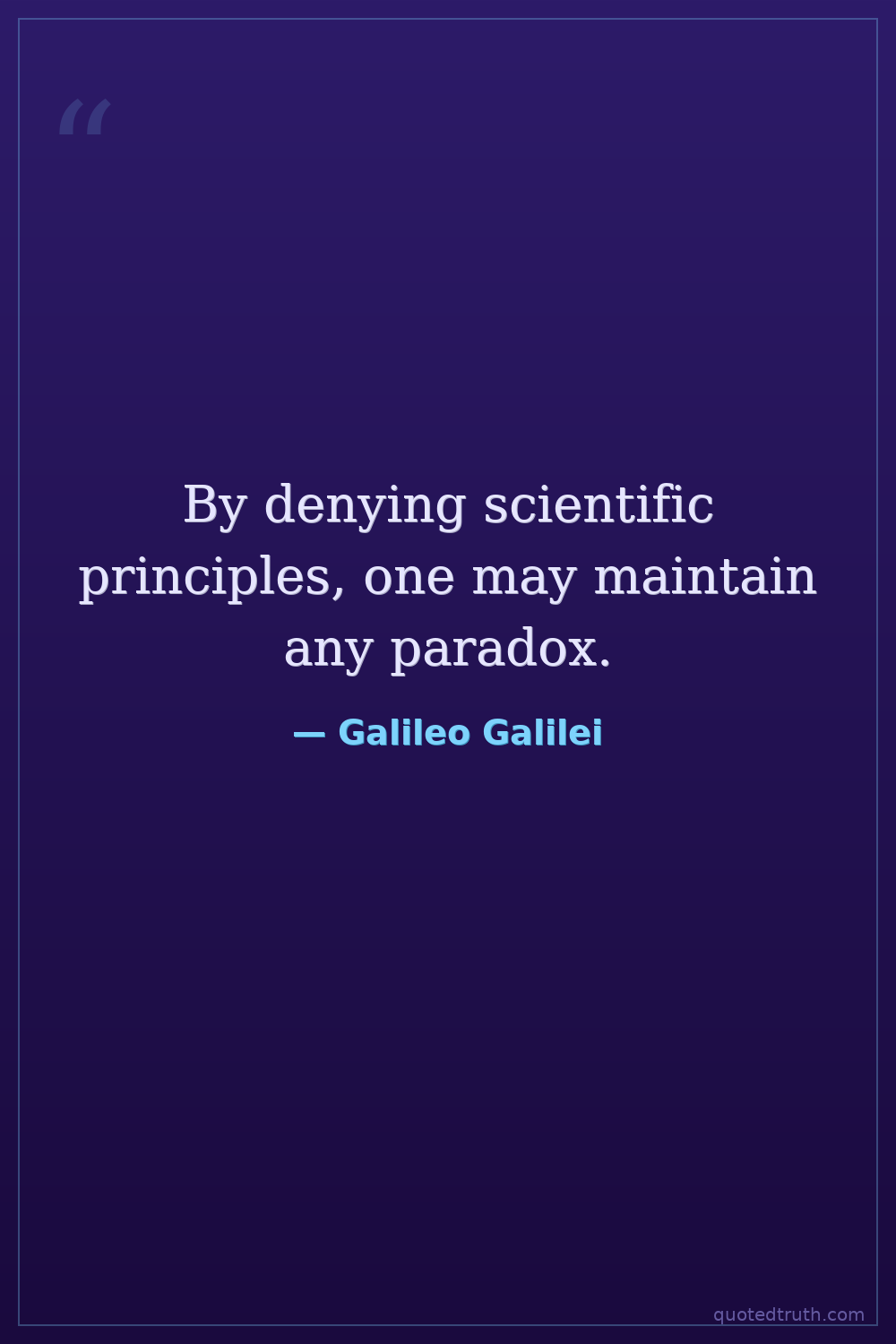
Galileo Galilei — "By denying scientific principles, one may maintain any paradox."
By denying scientific principles, one may maintain any paradox.
By denying scientific principles, one may maintain any paradox.
Click any product to generate a realistic preview. Up to 3 at a time.
* Initial load can take up to 90 seconds — revising the preview in another color is nearly instant.
"Facts which at first seem improbable will, even on scant explanation, drop the cloak which has hidden them and stand forth in naked and simple beauty."
"Nature does not make leaps."
"I am about to take leave of this earth, and I can say that I have seen more wonders than any man before me."
"It is a beautiful thing to know that the heavens are not immutable."
"I hold the sun to be situated motionless in the center of the revolution of the celestial orbs while the earth revolves around the sun."
Found in 1 providers: grok
1 source checked
When someone refuses to accept established facts and evidence, they can justify any absurd or contradictory belief they choose. Without shared empirical ground, rational debate collapses and anyone can claim anything is true, no matter how contradictory or unsupported. Rejecting foundational scientific truths doesn't make those truths disappear—it just untethers the denier from reality.
Galileo spent decades battling those who denied heliocentrism, telescope evidence, and celestial mechanics despite observable proof. The Church's Inquisition forced his 1633 recantation precisely by refusing his empirical demonstrations. He watched authorities maintain paradoxes—Earth at the universe's center despite Jupiter's moons, Venus's phases, and sunspot motion—by simply rejecting his methods.
The early 17th century pitted emerging empirical science against entrenched Aristotelian doctrine and Church authority. Scholasticism held that ancient texts outranked observation. Galileo's contemporaries genuinely maintained cosmological paradoxes by dismissing telescopic evidence as illusion, demonstrating exactly the phenomenon he described—authority substituting for evidence in an age before scientific consensus had institutional protection.
AI-generated insights based on extensive research and information for context. Factual errors? Email [email protected].
Your cart is empty