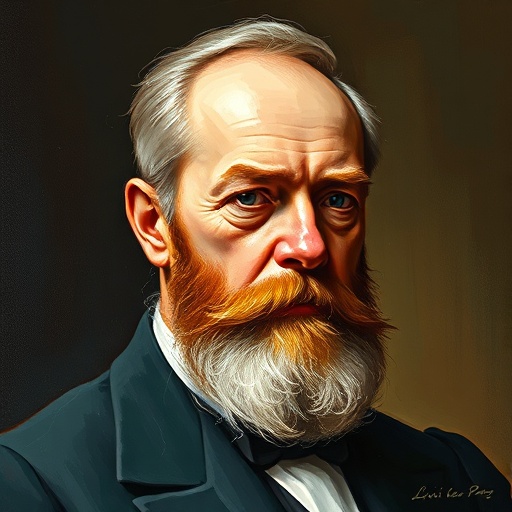
Louis Pasteur — "Chance only favors the prepared mind."
Chance only favors the prepared mind.
Chance only favors the prepared mind.
Click any product to generate a realistic preview. Up to 3 at a time.
* Initial load can take up to 90 seconds — revising the preview in another color is nearly instant.
"The day will come when the microbe is both friend and foe."
"I have great hopes that the vaccine against rabies will be a success."
"The cultivation of the soil is the noblest occupation of man."
"The greatest error is to believe that one knows everything."
"The scientific method is the only one that allows us to approach the truth."
Often cited as a paraphrase of his 1854 lecture. Slightly different wording than previous entry.
Date: 1854
WisdomFound in 3 providers: grok,gemini,deepseek
3 sources checked
Lucky breakthroughs rarely happen to people who stumble onto them unprepared. Discovery looks like chance from the outside, but it only lands on someone whose training, knowledge, and attention have already readied them to recognize what matters. The unexpected observation becomes useful only when the observer has the background to interpret it. In short, opportunity rewards those who have already done the hard preparatory work of learning, practicing, and thinking deeply about their field.
Pasteur lived this principle. His germ theory emerged because he was rigorously trained in chemistry and crystallography when he noticed microbes spoiling wine and beer. Pasteurization, vaccines for anthrax and rabies, and his demolition of spontaneous generation all came from seeing accidents others dismissed. Decades of disciplined laboratory work prepared him to interpret contaminated flasks and sickened livestock as evidence, turning what peers called luck into reproducible science that reshaped medicine and food safety.
Pasteur worked in mid-to-late 1800s France, when disease was blamed on bad air, spontaneous generation was mainstream, and surgery killed patients through unseen infection. The Industrial Revolution was scaling brewing, dairy, and silk industries plagued by mysterious spoilage and livestock epidemics. Scientific method was professionalizing, laboratories were becoming rigorous, and microscopy was maturing. In that climate, a trained chemist noticing tiny organisms could overturn centuries of dogma, which is exactly how prepared minds rewrote biology and public health.
AI-generated insights based on extensive research and information for context. Factual errors? Email [email protected].
Your cart is empty