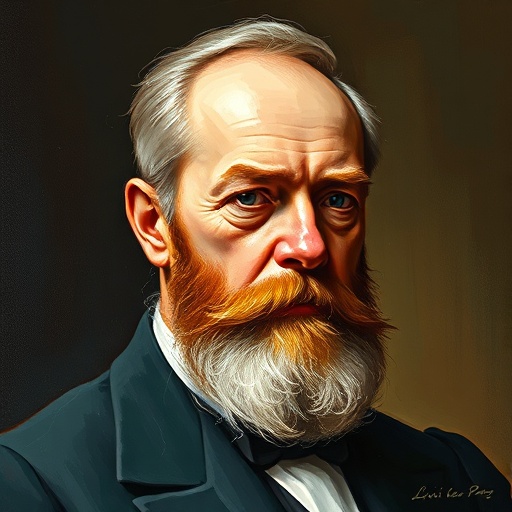
Louis Pasteur — "The scientific method is the only one that allows us to approach the truth."
The scientific method is the only one that allows us to approach the truth.
The scientific method is the only one that allows us to approach the truth.
Click any product to generate a realistic preview. Up to 3 at a time.
* Initial load can take up to 90 seconds — revising the preview in another color is nearly instant.
"When I approach a child, he inspires in me two sentiments: tenderness for what he is, and respect for what he may become."
"I have no doubt that I shall succeed in my experiments."
"The true character of a man is revealed in his actions, not in his words."
"Messieurs, c'est les microbes qui auront le dernier mot. (Gentlemen, it is the microbes who will have the last word.)"
"I am utterly convinced that there is a germ for every disease."
Attributed, underscoring his belief in empirical investigation.
Date: Late 19th Century (approx.)
WisdomFound in 1 providers: grok
1 source checked
Truth about the natural world isn't reached through tradition, authority, or intuition alone. Only systematic observation, hypothesis, controlled experiment, and repeated verification can get us closer to how things actually work. Every other path—guessing, believing, arguing from principle—leaves us stuck with opinions. The scientific method is uniquely self-correcting: it tests claims against reality and discards what fails, which is why it steadily narrows the gap between what we think and what is.
Pasteur lived this claim. He disproved spontaneous generation with his swan-neck flask experiment, proving microbes came from the air rather than arising on their own. He developed germ theory, pasteurization, and vaccines for anthrax and rabies by rigorous lab work, not speculation. Trained as a chemist, he insisted on controlled experiments against entrenched medical opinion, and his devout Catholic faith coexisted with uncompromising empirical standards in the laboratory.
In the 19th century, medicine still leaned on miasma theory, bloodletting, and folk remedies, while spontaneous generation was scientific orthodoxy. Pasteur worked amid fierce debates with figures like Félix Pouchet, and surgeons like Lister were only beginning to adopt antisepsis. The broader Industrial Revolution was elevating experimental science and engineering over tradition. Pasteur's insistence on method mirrored a wider cultural shift toward empiricism, positivism, and institutional laboratories replacing the gentleman-naturalist era.
AI-generated insights based on extensive research and information for context. Factual errors? Email [email protected].
Your cart is empty