What it means
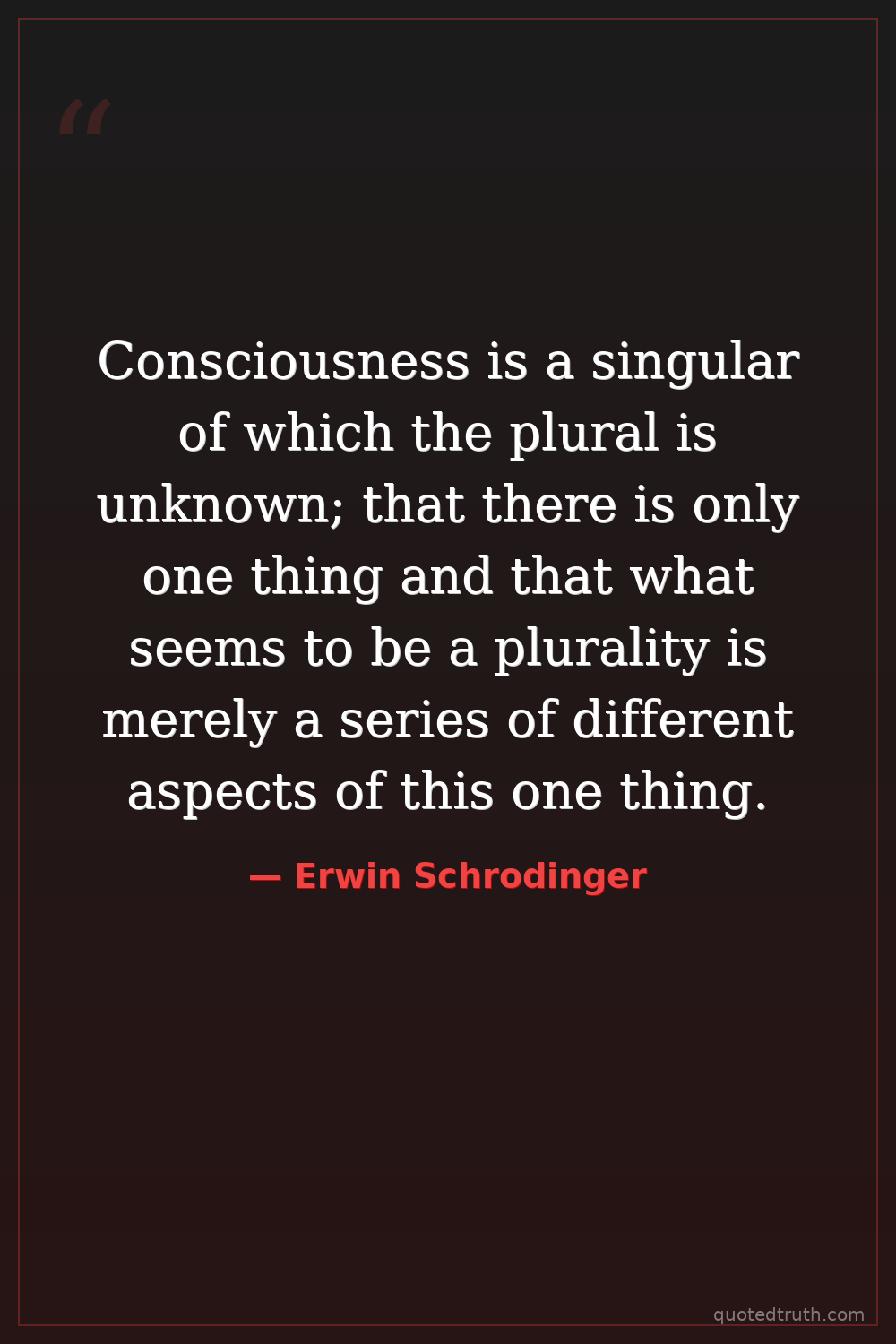
There is ultimately only one consciousness in existence, not billions of separate minds. What appears to be countless individual conscious beings are actually different facets or perspectives of a single underlying awareness. Our sense of being separate, isolated selves is an illusion created by perspective, like how one diamond appears to have many faces while remaining one stone.
Relevance to Erwin Schrodinger
Schrödinger, who formulated wave mechanics and the quantum superposition thought experiment bearing his cat's name, was deeply influenced by Vedantic Hindu philosophy. His book 'What is Life?' and 'Mind and Matter' explored consciousness scientifically. He believed physics ultimately pointed toward a unified reality, and his Eastern philosophical studies reinforced his conviction that individual selfhood was illusory—directly informing his quantum worldview.
The era
Schrödinger wrote this amid mid-20th century quantum mechanics revolution, when physicists confronted the observer's role in collapsing wave functions, forcing hard questions about the nature of consciousness. Post-WWII intellectual culture saw Western scientists increasingly engaging Eastern philosophy. The measurement problem in quantum theory—whether observation creates reality—made consciousness central to physics debates in ways previously unimaginable in classical Newtonian science.
AI-generated insights based on extensive research and information for context. Factual errors? Email [email protected].