What it means
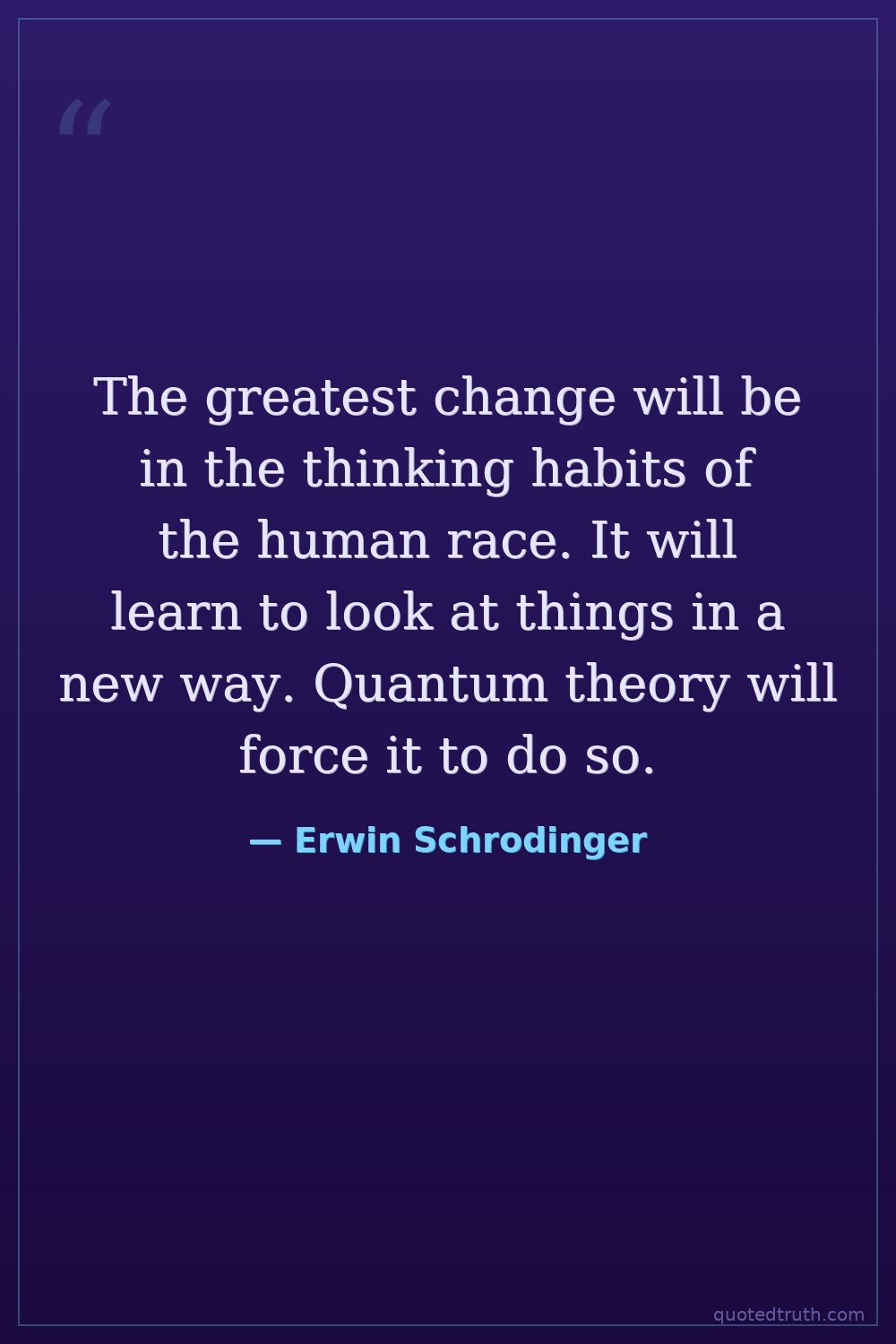
Quantum physics isn't merely a scientific upgrade—it demands an entirely new way of understanding reality. Classical thinking assumes objects have definite states, causes produce predictable effects, and observers don't disturb what they measure. Quantum theory violates all three. Schrödinger argues this paradigm shift will eventually transform how ordinary people reason about uncertainty, observation, and existence—not just physicists in laboratories, but anyone grappling with what it means to truly know something about the world.
Relevance to Erwin Schrodinger
Schrödinger developed wave mechanics in 1926, deriving the equation that mathematically describes quantum states—the foundation of modern quantum physics. His famous cat thought experiment deliberately forced the strangeness of superposition into everyday terms, showing he believed quantum logic had implications beyond physics. His book What Is Life? applied quantum reasoning to biology. He lived the intellectual tension between quantum formalism and human intuition, making him especially credible in predicting the theory's broader cultural impact.
The era
The 1920s–1940s saw quantum mechanics overturn three centuries of Newtonian certainty. The Bohr-Einstein debates about quantum reality's meaning raged through Copenhagen conferences in the 1930s. Simultaneously, existentialism was dismantling deterministic worldviews in philosophy and literature. Post-war nuclear devastation proved physics could reshape civilization. Western culture was absorbing that the mechanical, predictable universe was an illusion. Schrödinger recognized this wasn't just a physics revolution—it was a civilizational epistemological rupture filtering into everyday human reasoning.
AI-generated insights based on extensive research and information for context. Factual errors? Email [email protected].