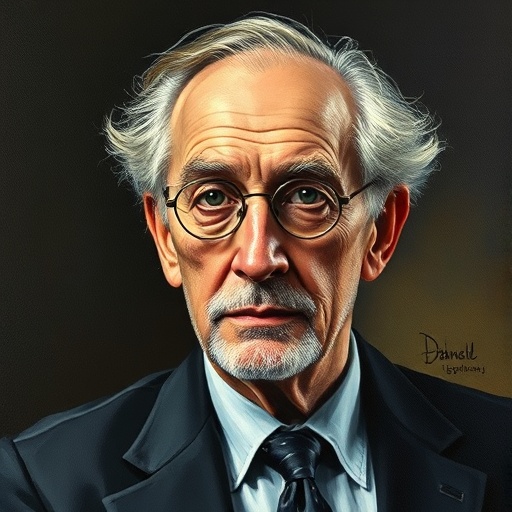
Francis Crick — "Consciousness is an emergent property of the brain."
Consciousness is an emergent property of the brain.
Consciousness is an emergent property of the brain.
Click any product to generate a realistic preview. Up to 3 at a time.
* Initial load can take up to 90 seconds — revising the preview in another color is nearly instant.
"The human brain is a very complicated machine."
"I would not trust any experiment in biology unless it was confirmed by a physicist."
"If you want to understand life, you have to understand DNA."
"The universe is not benign."
"What is true of the brain is true of the universe."
Found in 1 providers: grok
1 source checked
Consciousness — our inner awareness, thoughts, and subjective experience — is not a separate soul or mystical force, but a phenomenon that emerges from the brain's physical activity. Just as wetness emerges from water molecules interacting, consciousness arises from billions of neurons firing in concert. No single neuron is conscious; the collective system produces awareness. The implication: the mind is entirely biological, not magical or supernatural.
After co-discovering DNA's double helix with Watson in 1953, Crick spent his final decades as a neuroscientist at the Salk Institute, fixated on consciousness. His 1994 book The Astonishing Hypothesis, co-authored with Christof Koch, argued the soul is simply the behavior of neurons. A committed materialist and atheist, Crick rejected any spiritual dimension of mind, applying the same reductionist rigor he used cracking the genetic code.
Crick developed this view during the 1980s–2000s, when brain imaging technologies like fMRI were transforming neuroscience. Scientists could now watch the brain process thoughts in real time. Philosopher David Chalmers formalized the hard problem of consciousness in 1995, intensifying debate. Meanwhile, the Cold War's end and the Human Genome Project's progress fostered a techno-optimist belief that science could explain everything — including the subjective mind.
AI-generated insights based on extensive research and information for context. Factual errors? Email [email protected].
Your cart is empty