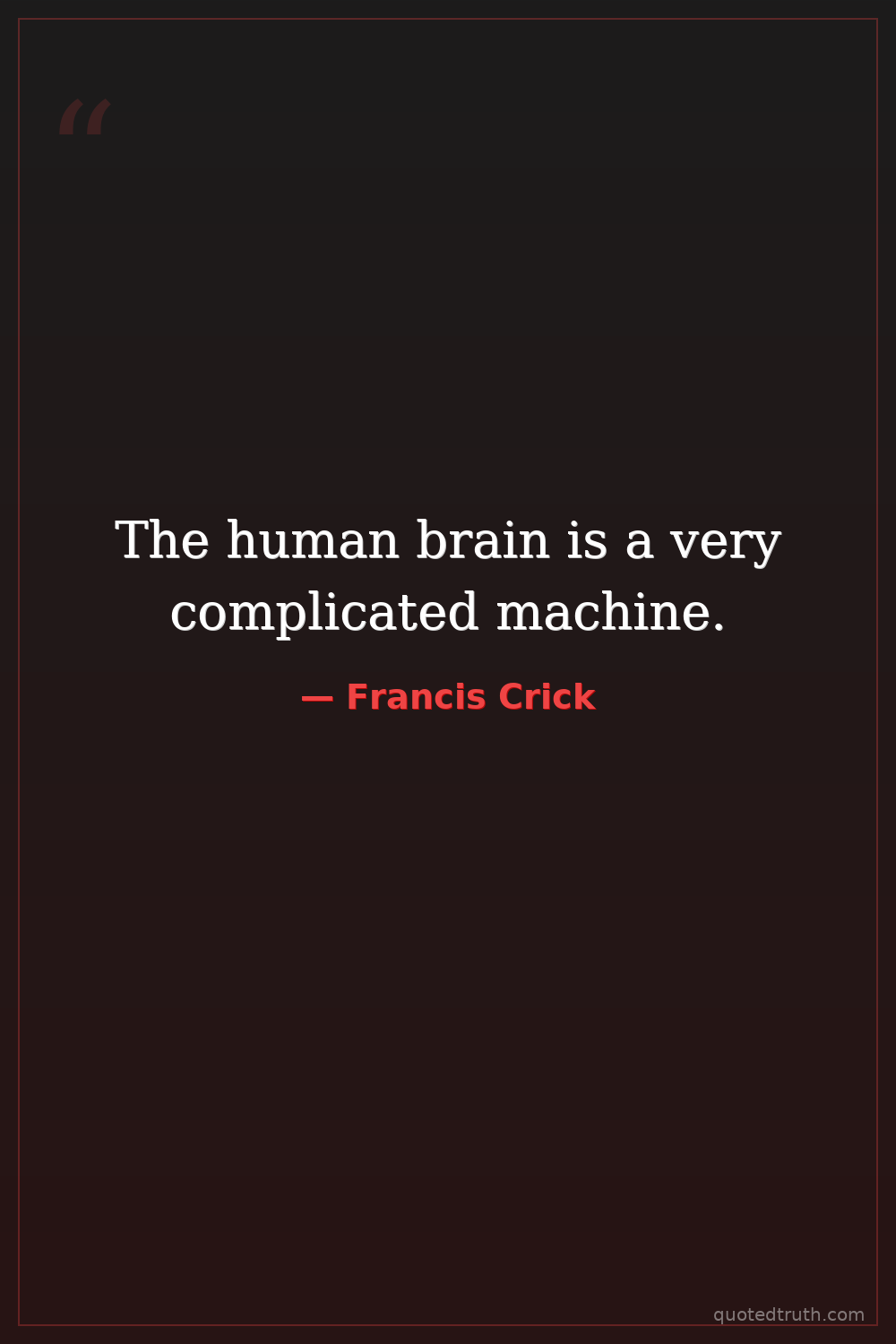
Francis Crick — "The human brain is a very complicated machine."
The human brain is a very complicated machine.
The human brain is a very complicated machine.
Click any product to generate a realistic preview. Up to 3 at a time.
* Initial load can take up to 90 seconds — revising the preview in another color is nearly instant.
"We are just a bunch of atoms and molecules."
"Free will is an illusion."
"The greatest joy in science is to understand something that no one else has understood before."
"We have discovered the secret of life."
"The brain is a machine that makes theories."
Found in 1 providers: grok
1 source checked
The brain is extraordinarily complex — more so than any device humans have ever built. It processes sensory input, generates consciousness, stores memories, and controls bodily functions simultaneously. Calling it a 'machine' implies it can, in principle, be fully understood through science and engineering, while acknowledging it's 'very complicated' admits that such understanding remains incomplete and may take generations of research to achieve.
After co-discovering DNA's double helix in 1953, Crick spent his later career obsessed with consciousness, collaborating with Christof Koch at the Salk Institute. His 1994 book 'The Astonishing Hypothesis' argued human emotions and identity are purely neural events. Calling the brain a 'machine' reflects his lifelong reductionist conviction that biology — even consciousness itself — can be fully explained through physical and chemical mechanisms, with no need for a soul.
Crick worked during neuroscience's explosive growth — the U.S. government declared the 1990s the 'Decade of the Brain,' fMRI was making brain activity visible for the first time, and early AI raised urgent questions about whether machines could replicate cognition. The quote challenges Cartesian dualism, asserting consciousness is purely physical at a moment when biology, computing, and philosophy were converging on questions about what makes humans human.
AI-generated insights based on extensive research and information for context. Factual errors? Email [email protected].
Your cart is empty