What it means
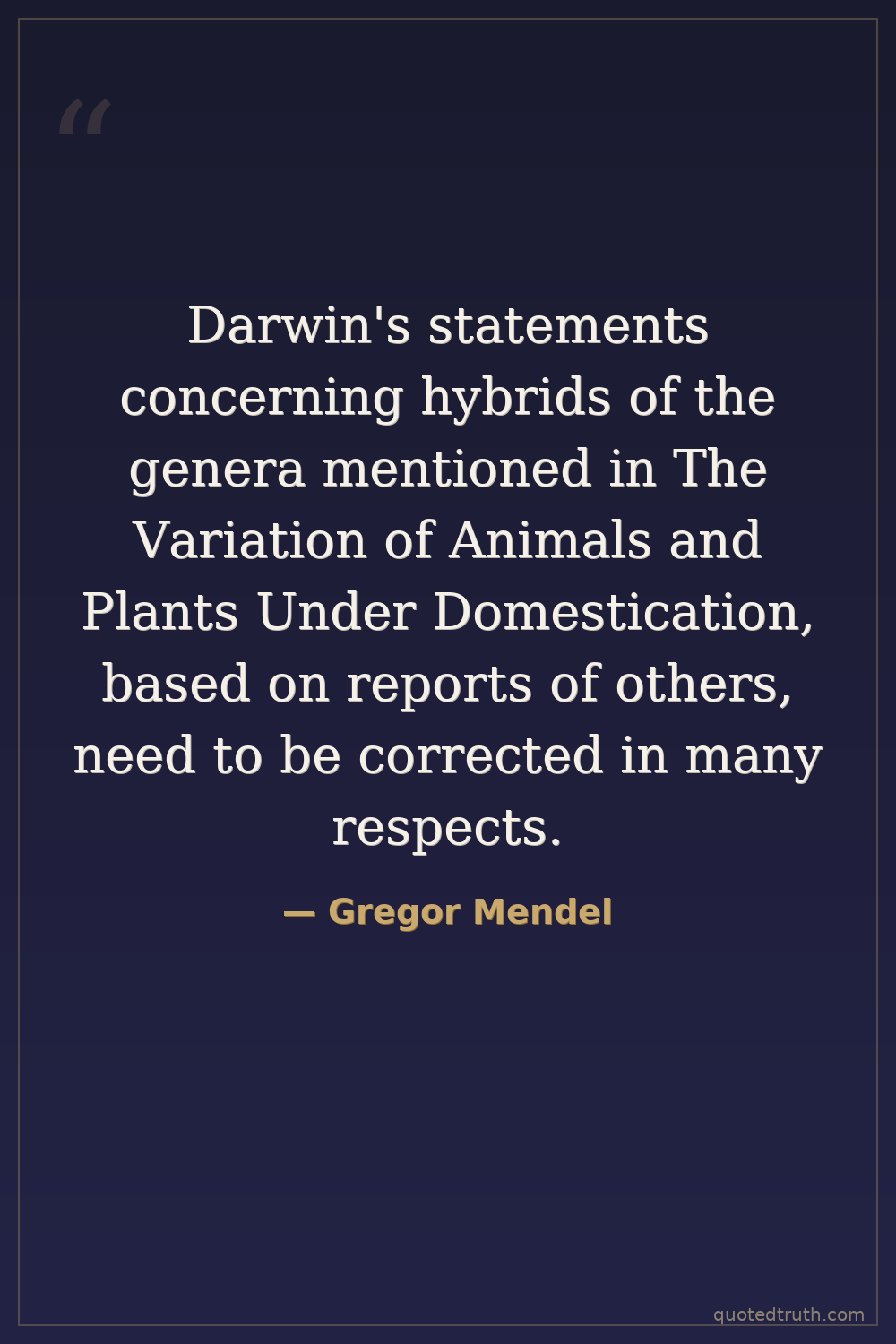
This quote asserts that Darwin's published claims about plant and animal hybrids — drawn from secondhand accounts rather than direct experimentation — contain multiple inaccuracies requiring correction. Mendel is not dismissing Darwin broadly, but targeting specific conclusions Darwin reached without performing controlled experiments himself. The statement reflects a core scientific principle: conclusions must rest on firsthand, reproducible data, not aggregated reports from others whose methods and conditions cannot be independently verified.
Relevance to Gregor Mendel
Mendel spent eight years conducting over 29,000 controlled pea-plant crosses in his monastery garden, meticulously tracking inheritance ratios across generations. His entire methodology rested on firsthand, quantified observation — the direct opposite of Darwin's habit of synthesizing others' reports. Correcting Darwin, the era's unchallenged authority on natural history, reflects Mendel's intellectual independence and deep trust in experimental rigor over reputation. He knew his own data was precise where Darwin's secondhand sources were not.
The era
Darwin's 'Variation of Animals and Plants Under Domestication' appeared in 1868, two years after Mendel's own heredity paper. Scientists had no concept of genes or chromosomes; Darwin himself proposed 'pangenesis,' a flawed heredity theory. Naturalists routinely compiled observations from farmers, breeders, and explorers rather than running controlled experiments. Mendel's critique exposed the fundamental methodological gap between observational natural history and experimental genetics — a tension that defined 19th-century biology and would not be resolved until the 1900s.
AI-generated insights based on extensive research and information for context. Factual errors? Email [email protected].