Pope Urban II — "Deus vult! (God wills it!)"
Deus vult! (God wills it!)
Deus vult! (God wills it!)
Click any product to generate a realistic preview. Up to 3 at a time.
* Initial load can take up to 90 seconds — revising the preview in another color is nearly instant.
"Let those who have been serving as mercenaries for small pay now obtain the eternal reward."
"Let those who have formerly been mercenaries at low wages, now gain eternal rewards. Let those who have been striving to the detriment both of body and soul, now labor for a two-fold reward."
"Let those who have been for a long time plunderers, now become Christian knights."
"What are you doing, sluggish race, if not to fight for Christ?"
"This royal city, therefore, situated at the center of the world, is now held captive by His enemies… From you especially she asks succor, because, as we have already said, God has conferred upon you a…"
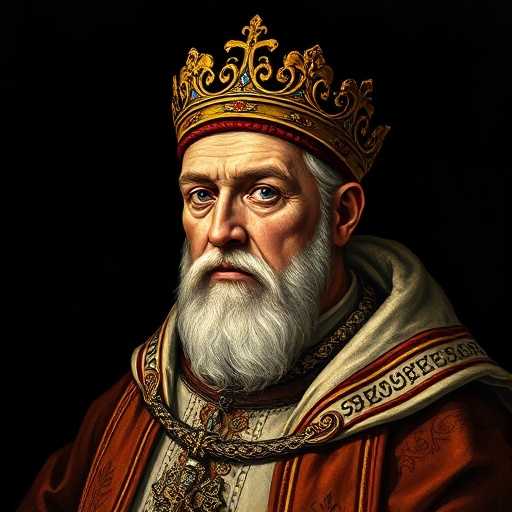
Pope (1088-1099) whose Council of Clermont speech (November 1095) launched the First Crusade — the founding event of nine centuries of Christian-Muslim military conflict. Closely associated with Pope Gregory VII (his predecessor on papal-imperial reform). For an intellectual contrast, see Saladin, Kurdish-Muslim Sultan of Egypt and Syria (1138-1193) — Saladin recaptured Jerusalem in 1187, undoing the First Crusade Urban II launched 92 years earlier. Saladin's chivalrous treatment of Christian prisoners became the canonical Muslim counter-image to Crusader brutality. The cleanest before/after pairing of the Crusades' moral arc.
Found in 2 providers: deepseek,gemini
2 sources checked
A declaration that divine will endorses a particular action, removing human moral responsibility by attributing the decision to God. It transforms personal or political choices into sacred obligations, compelling believers to act without hesitation or doubt. The phrase collapses the distance between human ambition and divine command, making obedience to the cause equivalent to obedience to God himself.
Urban II coined this phrase at the Council of Clermont in 1095, delivering arguably the most consequential sermon in medieval history. As pope, he wielded spiritual authority to mobilize European armies toward Jerusalem. His genius was framing territorial war as divine mission, leveraging his office's claim to speak for God to override secular reluctance and unite fractious Christian kingdoms under a single holy cause.
In 1095, the Seljuk Turks had seized Jerusalem and threatened Constantinople. European Christendom was fractured by feudal conflicts and papal-emperor power struggles. The Church needed a unifying moral crusade. Urban's proclamation transformed a Byzantine military request into a pan-Christian holy war, channeling noble violence outward. The crowd's spontaneous response at Clermont—shouting 'Deus vult!'—shows how perfectly the phrase captured the era's religious fervor.
AI-generated insights based on extensive research and information for context. Factual errors? Email [email protected].
Your cart is empty