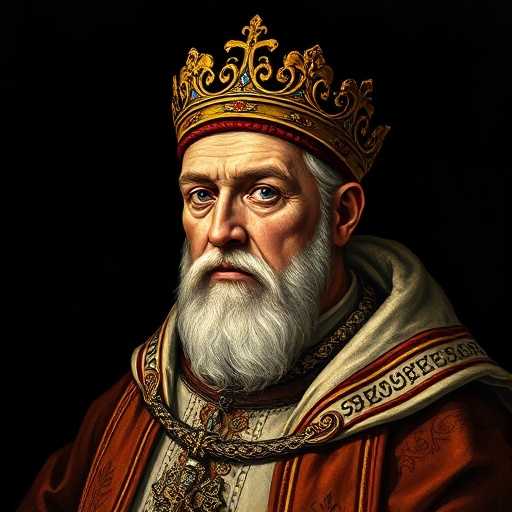
Pope Urban II — "What are you doing, sluggish race, if not to fight for Christ?"
What are you doing, sluggish race, if not to fight for Christ?
What are you doing, sluggish race, if not to fight for Christ?
Click any product to generate a realistic preview. Up to 3 at a time.
* Initial load can take up to 90 seconds — revising the preview in another color is nearly instant.
"The land of the Lord is now held by the infidels."
"Let no delay postpone the journey, but let all, having leased their lands and collected money, when winter has ended and spring has begun, zealously set out on the road with God as their guide."
"Undertake this journey for the remission of your sins, with the assurance of the imperishable glory of the kingdom of heaven."
"For your brethren who live in the East are in urgent need of your help... the Turks and Arabs have attacked them."
"They destroy the altars, after having defiled them with their uncleanness. They circumcise the Christians, and the blood of the circumcision they either spread upon the altars or pour into the vases o…"
Pope (1088-1099) whose Council of Clermont speech (November 1095) launched the First Crusade — the founding event of nine centuries of Christian-Muslim military conflict. Closely associated with Pope Gregory VII (his predecessor on papal-imperial reform). For an intellectual contrast, see Saladin, Kurdish-Muslim Sultan of Egypt and Syria (1138-1193) — Saladin recaptured Jerusalem in 1187, undoing the First Crusade Urban II launched 92 years earlier. Saladin's chivalrous treatment of Christian prisoners became the canonical Muslim counter-image to Crusader brutality. The cleanest before/after pairing of the Crusades' moral arc.
Speech at the Council of Clermont, as recorded by Guibert of Nogent
Date: 1095
Social & RacialFound in 1 providers: grok
1 source checked
A rhetorical challenge designed to shame Christian inaction. Urban frames idleness as spiritual failure and military service as the obvious expression of Christian identity. The phrase 'sluggish race' is a deliberate insult meant to provoke shame and galvanize listeners through wounded pride. He implies that any Christian not fighting for Christ is squandering their existence — duty, honor, and faith collapsed into a single accusation.
Urban II, a Cluniac monk turned pope, delivered this call at the Council of Clermont in 1095. His papacy centered on reforming a church he viewed as passive and morally lax. He positioned the pope as supreme commander of Christendom's spiritual and military forces. This quote reflects his conviction that Christian identity required active sacrifice, and his willingness to wield shame as a tool of ecclesiastical leadership to mobilize an entire civilization.
In 1095, Seljuk Turks held Jerusalem and had routed Byzantine forces at Manzikert in 1071. Western Europe's warrior aristocracy craved land, glory, and absolution for endemic violence. The Church's Peace of God movement had tried to suppress noble warfare domestically. Urban redirected that martial culture outward, framing the crusade as pilgrimage and holy war simultaneously — transforming knights from chronic sinners into instruments of God's will.
AI-generated insights based on extensive research and information for context. Factual errors? Email [email protected].
Your cart is empty