What it means
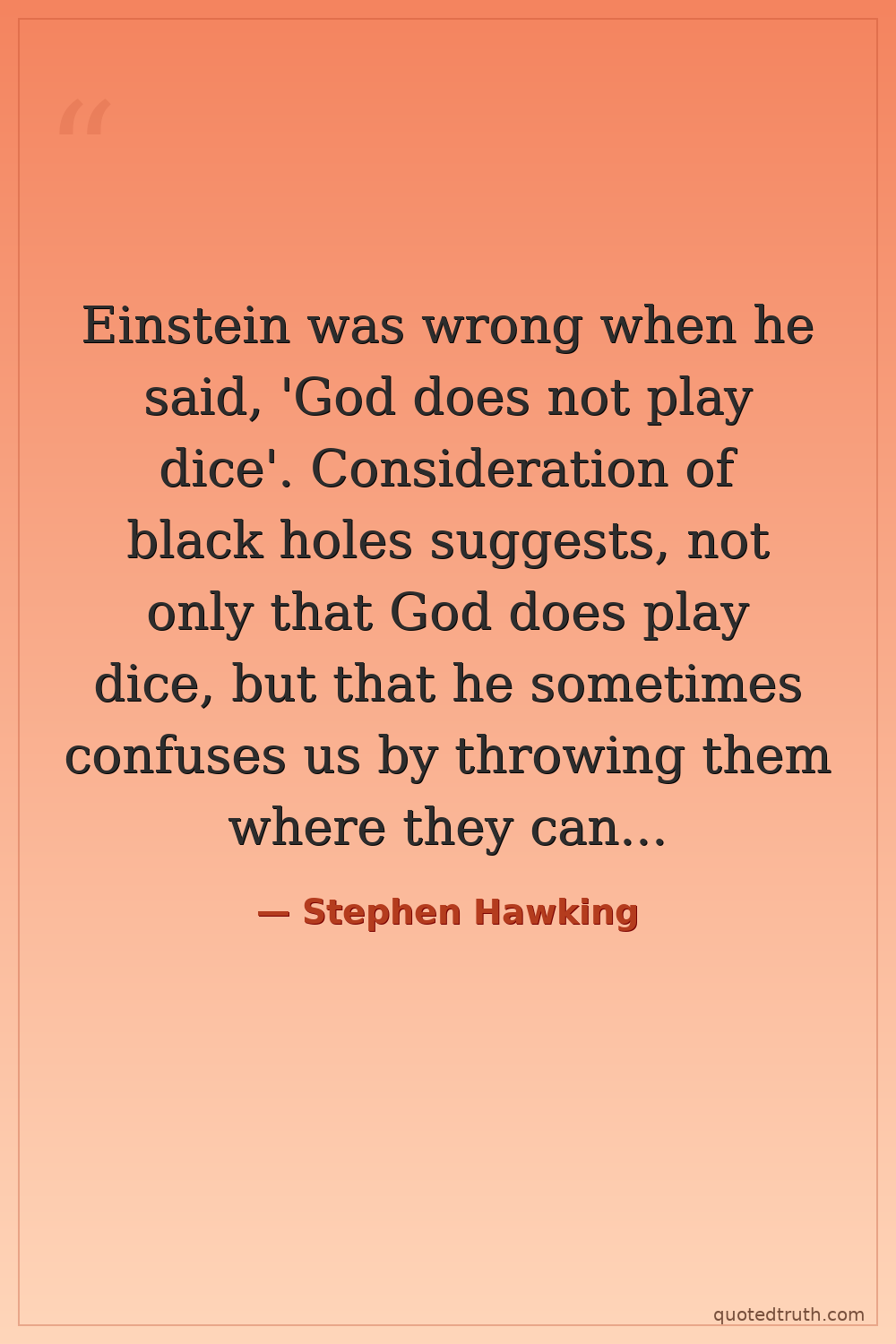
Einstein's phrase meant the universe follows fixed, deterministic rules with no true randomness. Hawking argues the opposite: quantum mechanics proves randomness is real and inescapable. Black holes intensify this further — whatever crosses the event horizon is permanently lost to outside observers. The universe doesn't just embrace chance; it hides the outcomes where no measurement can reach them, making reality more fundamentally unknowable than Einstein ever conceded.
Relevance to Stephen Hawking
In 1974, Hawking proved black holes emit thermal radiation — a quantum result Einstein's classical relativity never predicted. His career's central mission was unifying quantum mechanics with general relativity, the precise tension this quote captures. Confined to a wheelchair by ALS yet producing transformative physics, Hawking personally understood confronting hidden, uncontrollable outcomes. Publicly correcting Einstein — the towering legend of modern physics — exemplifies his intellectual fearlessness and refusal to treat any authority as beyond challenge.
The era
The 1970s marked quantum mechanics' full scientific triumph, yet Einstein's deterministic worldview remained philosophically compelling to many physicists. Hawking's 1974 black hole radiation paper electrified the field by merging quantum theory with curved spacetime for the first time. Space exploration was expanding humanity's cosmic perspective, and fierce debate raged over whether physical laws were ultimately deterministic. The information paradox Hawking introduced that decade remains one of theoretical physics' defining unsolved problems today.
AI-generated insights based on extensive research and information for context. Factual errors? Email [email protected].