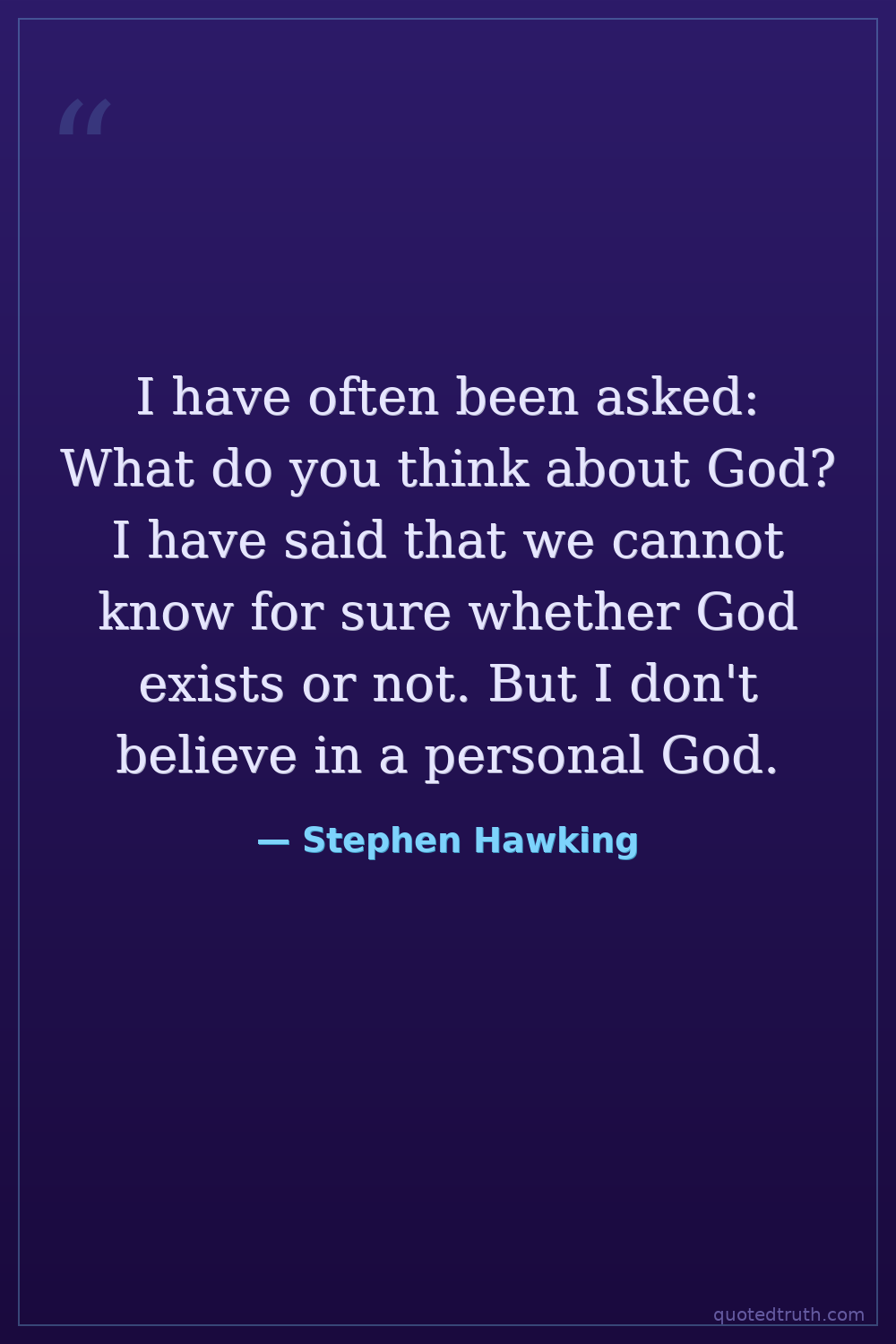
Stephen Hawking — "I have often been asked: What do you think about God? I have said that we cannot…"

I have often been asked: What do you think about God? I have said that we cannot know for sure whether God exists or not. But I don't believe in a personal God.
Stephen Hawking — Stephen Hawking Contemporary · Black holes, cosmology

Get This Quote & Author's Image Illustrated On:

Click any product to generate a realistic preview. Up to 3 at a time.
* Initial load can take up to 90 seconds — revising the preview in another color is nearly instant.

Kitchen

Apparel

Other

About Stephen Hawking (1942-2018)

British theoretical physicist whose Hawking radiation work and A Brief History of Time (1988) brought black-hole physics to a mass audience while he lived with ALS for 55 years. Closely associated with Roger Penrose (his collaborator on singularity theorems) and Carl Sagan (fellow popularizer who wrote Brief History's foreword). For an intellectual contrast, see William Lane Craig, American philosopher of religion — Craig's Kalam cosmological argument depends on the Big Bang requiring a divine first cause; Hawking's no-boundary proposal was specifically designed to remove the moment that would require one — the cleanest cosmology-vs-natural-theology contrast in modern thought.

Details

From 'Brief Answers to the Big Questions'

Date: 2018 (posthumous)

Biblical

Verification

Unverifiable

Found in 1 providers: grok

1 source checked

Understanding this quote

What it means

We lack definitive proof either way about God's existence, so intellectual honesty demands agnosticism on that question. However, a God who intervenes in individual lives, answers prayers, or cares about personal human affairs is a different and more specific claim — one that conflicts with how physics describes a universe governed entirely by natural laws operating without supernatural interruption.

Relevance to Stephen Hawking

Hawking spent his career demonstrating that the universe's origin and structure — the Big Bang, black hole radiation, no-boundary cosmology — require no divine designer. His Brief History of Time and later The Grand Design argued physics alone explains creation. Paralyzed from ALS yet intellectually prolific, he embodied human reason triumphing over circumstance, making supernatural intervention in personal affairs feel especially implausible to him.

The era

Hawking worked during late 20th and early 21st century debates where cosmology increasingly challenged religious cosmogony. The Hubble Space Telescope, COBE satellite mapping cosmic microwave background radiation, and string theory all suggested a self-contained universe. Meanwhile New Atheism surged publicly with Dawkins and Hitchens, and Hawking's celebrity gave his careful agnostic-but-naturalist position unusual cultural weight across both scientific and religious communities.

AI-generated insights based on extensive research and information for context. Factual errors? Email [email protected].
Your Cart

Your cart is empty