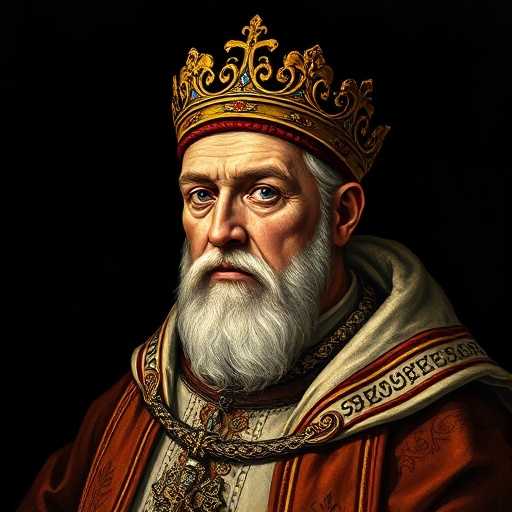
Pope Urban II — "Enter upon the road to the Holy Sepulcher; wrest that land from the wicked race,…"
Enter upon the road to the Holy Sepulcher; wrest that land from the wicked race, and subject it to yourselves.
Enter upon the road to the Holy Sepulcher; wrest that land from the wicked race, and subject it to yourselves.
Click any product to generate a realistic preview. Up to 3 at a time.
* Initial load can take up to 90 seconds — revising the preview in another color is nearly instant.
"But if you are hindered by love of children, parents and wives, remember what the Lord says in the Gospel, 'He that loveth father or mother more than me, is not worthy of me.'"
"Your land, moreover, is too poor to support you."
"The royal city, situated at the center of the world, is now held captive by His enemies, and is enslaved by peoples who do not know God."
"The Most High has chosen you for this glorious task."
"Oh, race of Franks, race from across the mountains, race chosen and beloved by God as shines forth in very many of your works... We wish you to know what a grievous cause has led us to your country, w…"
Pope (1088-1099) whose Council of Clermont speech (November 1095) launched the First Crusade — the founding event of nine centuries of Christian-Muslim military conflict. Closely associated with Pope Gregory VII (his predecessor on papal-imperial reform). For an intellectual contrast, see Saladin, Kurdish-Muslim Sultan of Egypt and Syria (1138-1193) — Saladin recaptured Jerusalem in 1187, undoing the First Crusade Urban II launched 92 years earlier. Saladin's chivalrous treatment of Christian prisoners became the canonical Muslim counter-image to Crusader brutality. The cleanest before/after pairing of the Crusades' moral arc.
A direct command to conquer the Holy Land from the 'wicked race' (Muslims). (Robert the Monk's account)
Date: 1095
ReligiousFound in 2 providers: gemini,grok
2 sources checked
A direct command to Christian warriors to march to Jerusalem, seize the city and surrounding holy sites from Muslim rulers, and establish Christian dominion over the region. It frames military conquest as righteous reclamation, portraying the existing rulers as inherently wicked and the land as something owed to Christians by divine right. The imperative verbs—enter, wrest, subject—leave no room for hesitation or moral ambiguity about the violence being sanctioned.
Urban II delivered these exact words at the Council of Clermont in 1095, the speech that launched the First Crusade. A former Cluniac monk turned pope, he combined genuine religious conviction with shrewd political calculation—redirecting Europe's restless warrior class toward a holy war would serve the Church while easing internal Christian violence. He never saw the result: he died in July 1099, two weeks after Crusaders breached Jerusalem's walls.
The Seljuk Turks had overrun Anatolia and tightened control over Jerusalem, alarming Byzantine Emperor Alexios I, who appealed to Rome for military aid. Christian pilgrimage routes had become dangerous. Simultaneously, European knights had no external enemy to absorb their aggression. The 1054 Great Schism had fractured Christendom, and papal authority was contested. Urban saw the Crusade as a chance to unite Latin Europe under Rome, restore pilgrim access, and assert supreme papal leadership over secular rulers.
AI-generated insights based on extensive research and information for context. Factual errors? Email [email protected].
Your cart is empty