Pope Urban II — "Your land, moreover, is too poor to support you."
Your land, moreover, is too poor to support you.
Your land, moreover, is too poor to support you.
Click any product to generate a realistic preview. Up to 3 at a time.
* Initial load can take up to 90 seconds — revising the preview in another color is nearly instant.
"Oh, what a disgrace if such a despised and base race, which worships demons, should conquer a people which has the faith of omnipotent God and has been made glorious with the name of Christ!"
"Let no one imagine that this expedition is for the sake of plunder, but for the remission of sins."
"The royal city, situated at the center of the world, is now held captive by His enemies, and is enslaved by peoples who do not know God."
"Remember that you were born of noble blood, and do not degenerate from the valor of your ancestors, but remember their deeds."
"It is no longer a matter of avenging just the injuries made to men, but rather those made to God. It is no longer a matter of attacking a city or a castle, but of conquering the Holy Places. If you tr…"
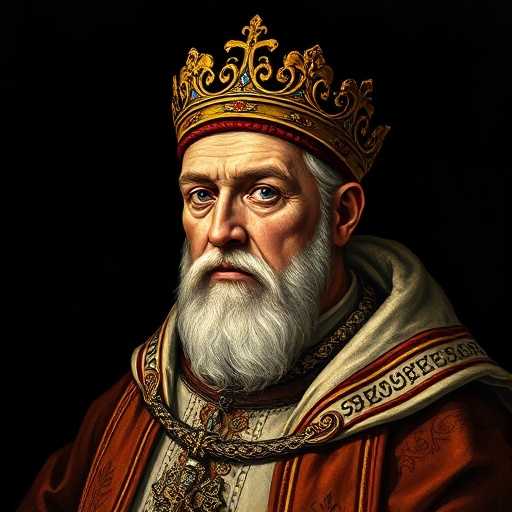
Pope (1088-1099) whose Council of Clermont speech (November 1095) launched the First Crusade — the founding event of nine centuries of Christian-Muslim military conflict. Closely associated with Pope Gregory VII (his predecessor on papal-imperial reform). For an intellectual contrast, see Saladin, Kurdish-Muslim Sultan of Egypt and Syria (1138-1193) — Saladin recaptured Jerusalem in 1187, undoing the First Crusade Urban II launched 92 years earlier. Saladin's chivalrous treatment of Christian prisoners became the canonical Muslim counter-image to Crusader brutality. The cleanest before/after pairing of the Crusades' moral arc.
Found in 1 providers: grok
1 source checked
The speaker argues that the homeland cannot sustain its population—resources are scarce, farmland is insufficient, and people are struggling to survive where they are. The solution implied is expansion outward: leaving for somewhere richer and more viable. It frames migration or conquest not as aggression but as necessity, a survival imperative driven by material conditions rather than purely by desire.
Urban II delivered this argument at Clermont in 1095 to mobilize European Christians toward Jerusalem. As pope, he needed practical motivations beyond religious zeal to convince knights and peasants to undertake dangerous campaigns. He understood feudal Europe's chronic overpopulation and land shortage pressures, and strategically framed the Crusade as economic relief alongside holy war, appealing to younger sons with no inheritance prospects.
Medieval Europe in the late 11th century faced genuine agrarian stress: population growth outpaced arable land, primogeniture left younger noble sons landless, and repeated famines struck. Feudal lords competed violently for territory. Urban II spoke at a moment when surplus warriors and desperate peasants needed redirection—the Crusade offered land, plunder, and purpose, channeling internal European violence toward an external holy objective.
AI-generated insights based on extensive research and information for context. Factual errors? Email [email protected].
Your cart is empty