What it means
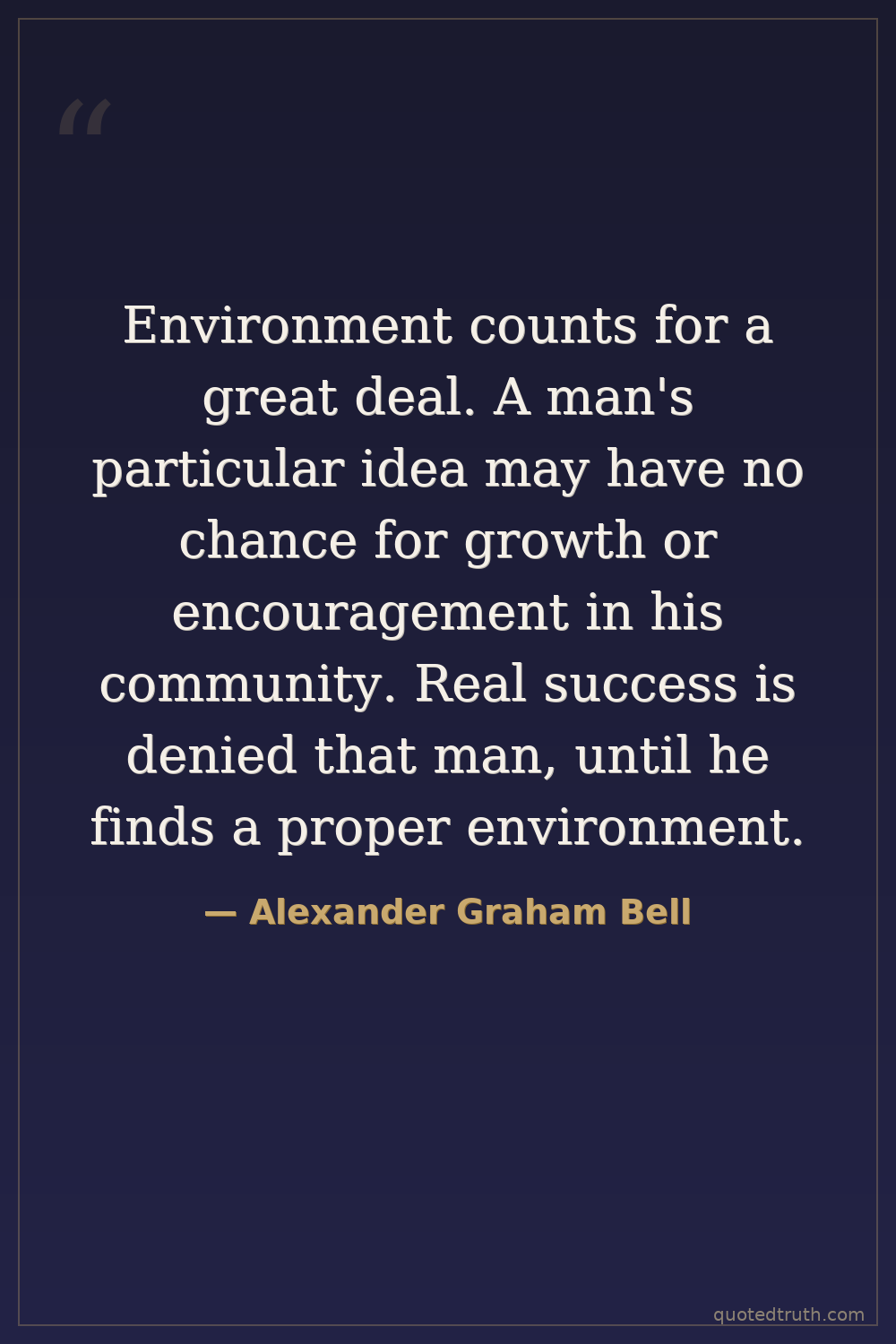
Your surroundings—the people, culture, and community around you—determine whether your ideas can actually grow. A brilliant concept stuck in an unsupportive environment will never reach its potential. Real achievement requires more than a good idea; it demands a community that recognizes, encourages, and enables that idea. Finding the right environment isn't a luxury—it's a prerequisite for turning vision into meaningful, lasting success.
Relevance to Alexander Graham Bell
Bell lived this principle firsthand. Born in Scotland, he relocated to Canada then Boston specifically seeking intellectual and financial support for his experiments. Boston's academic ecosystem, investors like Gardiner Hubbard, and access to skilled craftsmen gave him everything Edinburgh lacked. His work with the deaf—shaped by his deaf mother and wife—also depended on communities receptive to communication science. He later built the Volta Laboratory to deliberately create that nurturing environment for others.
The era
Bell's peak years (1870s–1900s) fell during America's Gilded Age, when geography was destiny for inventors. Industrial cities like Boston and New York concentrated capital, universities, patent attorneys, and technical labor that rural inventors simply couldn't access. Many contemporaries with genuine innovations died obscure because their communities offered no support. The era's rapid urbanization made Bell's observation a practical survival rule—environment wasn't philosophy, it was the concrete difference between a patent and a forgotten notebook.
AI-generated insights based on extensive research and information for context. Factual errors? Email [email protected].