What it means
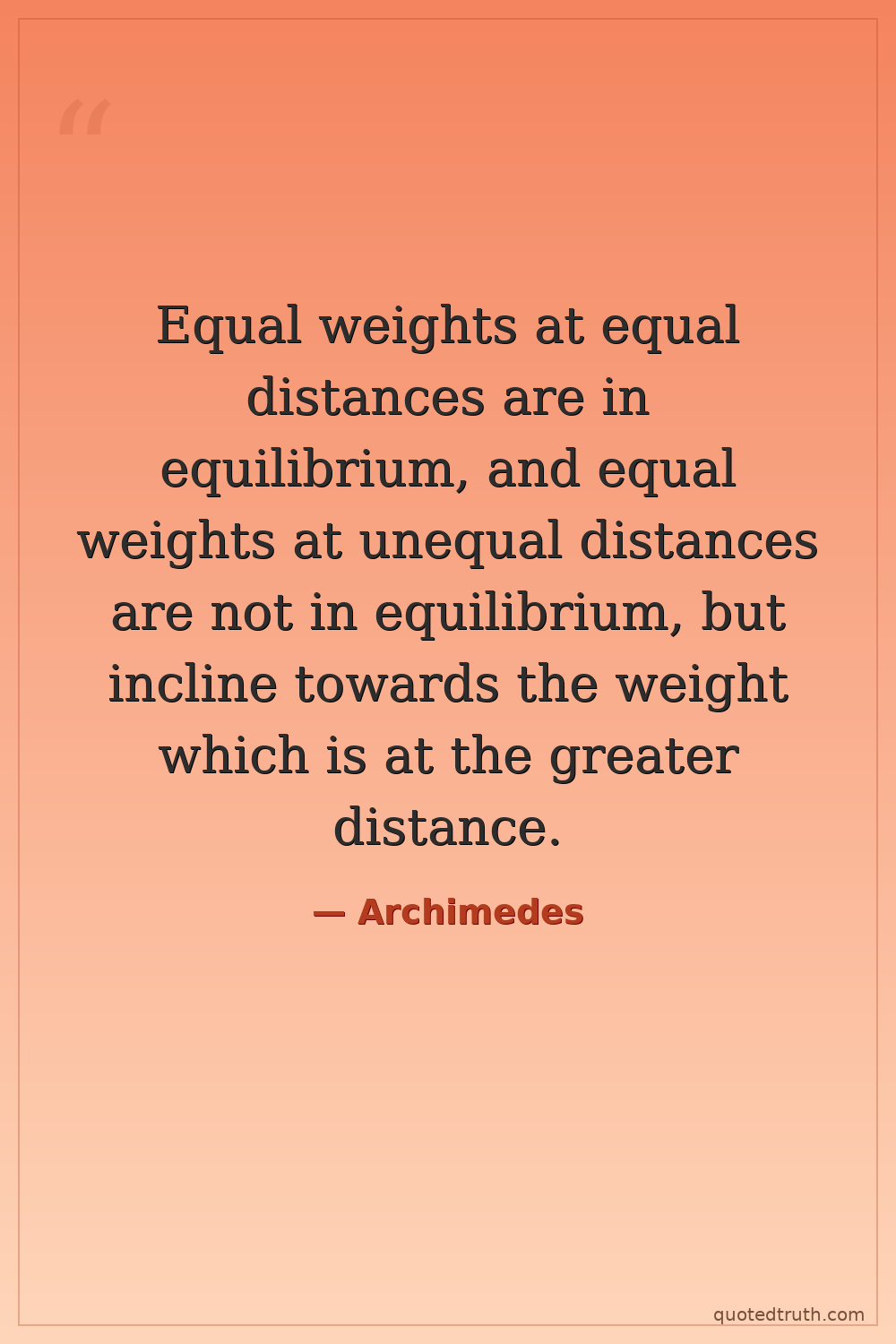
If two equal weights sit at equal distances from a pivot point, the system balances perfectly. But place those same equal weights at different distances, and the system tips toward whichever weight sits farther away. Distance from the fulcrum amplifies force — a small weight far out can overpower a heavy weight close in. This is the precise mechanical law governing levers, balances, and any system of distributed forces.
Relevance to Archimedes
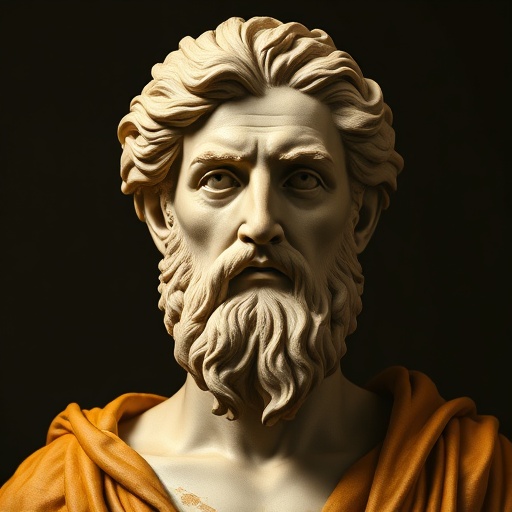
Archimedes built his career on the lever's power — he reportedly boasted he could move the Earth given a long enough lever and a place to stand. This quote is from his treatise On the Equilibrium of Planes, where he proved lever laws with geometric rigor. He applied those same principles to engineer war machines that held off Rome's siege of Syracuse for years, turning abstract math into battlefield reality.
The era
In third-century BC Syracuse, Greek thinkers debated physics philosophically, without mathematical proof. Archimedes broke from tradition by treating mechanics like geometry — stating axioms and deriving theorems. This coincided with the flourishing of the Library of Alexandria, the hub of Hellenistic science. His formal proof of lever laws was unprecedented: the first time physical behavior was rigorously derived from first principles, bridging pure mathematics and the physical world.
AI-generated insights based on extensive research and information for context. Factual errors? Email [email protected].