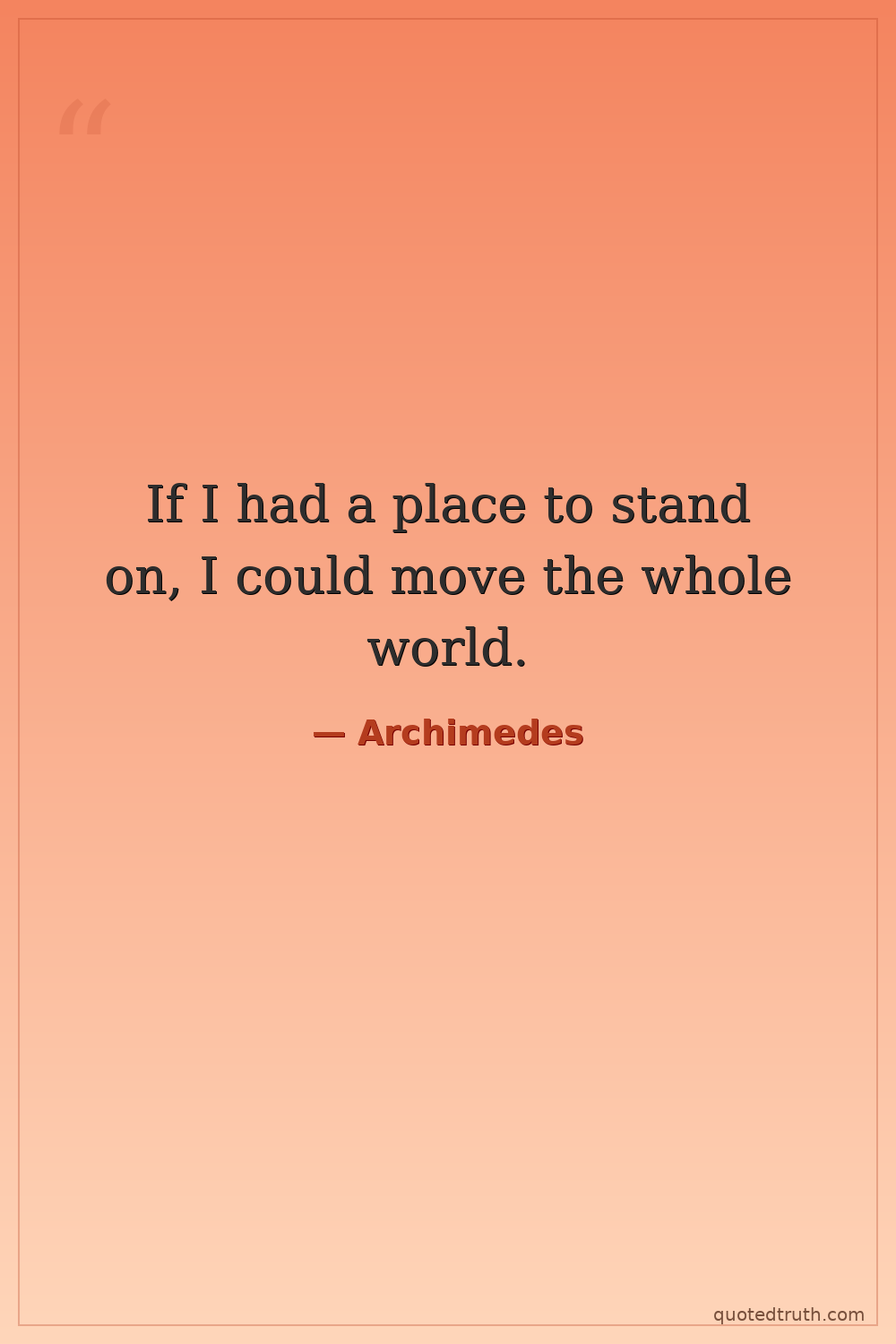
Archimedes — "If I had a place to stand on, I could move the whole world."
If I had a place to stand on, I could move the whole world.
If I had a place to stand on, I could move the whole world.
Click any product to generate a realistic preview. Up to 3 at a time.
* Initial load can take up to 90 seconds — revising the preview in another color is nearly instant.
"It is a property of the circle that the ratio of its circumference to its diameter is the same for all circles."
"Mathematics reveals its secrets only to those who approach it with pure love, for its own beauty."
"There are some who think that the number of the sand is infinite in multitude."
"The greatest pleasure is to discover."
"Noli turbare circulos meos."
A slightly different translation of his lever quote, emphasizing the hypothetical power.
Date: c. 250 BCE
GeneralFound in 1 providers: grok
1 source checked
Power lies not in brute force but in position and principle. A lever with the right fulcrum can move any weight — the longer the arm, the less effort required. It captures a universal truth: find the correct vantage point, physical, intellectual, or strategic, and enormous tasks become achievable. No limit is absolute; limits are reframed as problems of geometry and positioning, solvable through the right application of known laws rather than raw strength.
Archimedes formally proved the law of the lever in On the Equilibrium of Planes, then demonstrated compound pulleys by single-handedly hauling a fully loaded ship for King Hiero II. He spent his life translating abstract mathematics into mechanical reality — war machines, the Archimedes screw, celestial models. This statement is not metaphor for him; it is a literal engineering claim grounded in mathematical proof he had already rigorously completed and published.
In 3rd-century BC Syracuse, Greek science was transitioning from philosophy to applied mechanics. Rome's expanding republic threatened Greek city-states militarily, making engineering decisive — Archimedes designed catapults and claw machines that held off Roman siege forces for years. Most ancient engineering relied on manpower and intuition. His mathematical formalization of mechanical advantage was radical: it suggested natural laws, not gods or raw strength, governed physical possibility, reshaping how educated Greeks understood human capability.
AI-generated insights based on extensive research and information for context. Factual errors? Email [email protected].
Your cart is empty