Leonardo da Vinci — "Experience is never wrong; only our judgments are wrong in promising themselves …"
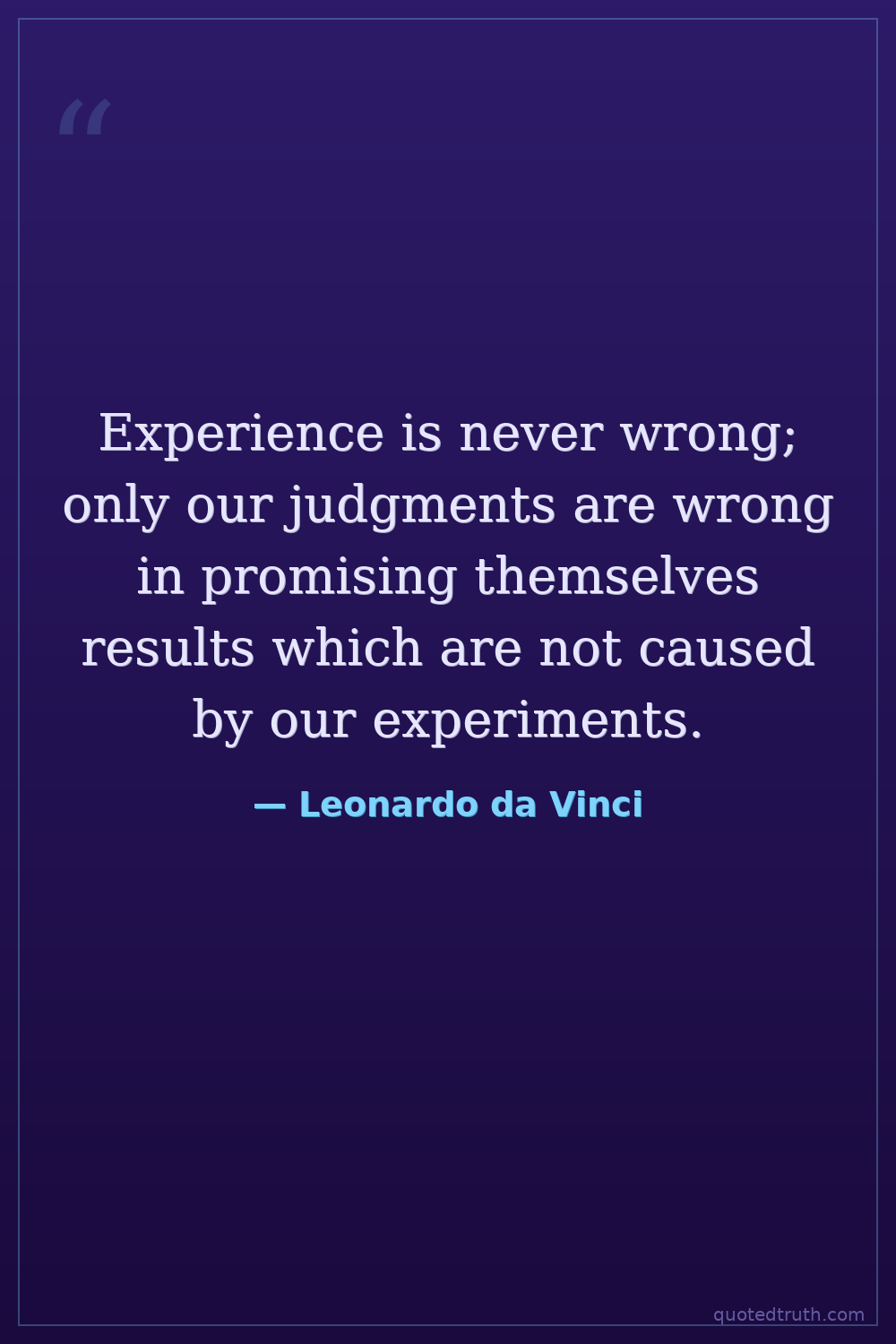
Experience is never wrong; only our judgments are wrong in promising themselves results which are not caused by our experiments.
Experience is never wrong; only our judgments are wrong in promising themselves results which are not caused by our experiments.
Click any product to generate a realistic preview. Up to 3 at a time.
* Initial load can take up to 90 seconds — revising the preview in another color is nearly instant.
"I have been impressed with the urgency of doing. Knowing is not enough; we must apply. Being willing is not enough; we must do."
"Oh! how many are the times that I have been deceived!"
"The body, which is subject to the changes of the sky, changes with the sky."
"Iron rusts from disuse; stagnant water loses its purity and in cold weather becomes frozen; even so does inaction sap the vigor of the mind."
"As every divided kingdom falls, so every mind divided between many studies confounds and saps itself."
Found in 1 providers: grok
1 source checked
Our direct observations of the world are always accurate — reality simply is what it is. The errors arise in our minds when we draw conclusions or make predictions that go beyond what the evidence actually supports. Faulty reasoning, overconfidence, and wishful thinking corrupt our interpretations, not the raw data itself. True knowledge requires disciplined, honest evaluation of what experiments actually demonstrate.
Da Vinci filled thousands of notebook pages with meticulous observations of anatomy, water flow, bird flight, and mechanics. He was a relentless empiricist before the scientific method was formalized, repeatedly returning to direct observation over inherited authority. His anatomical dissections and engineering tests constantly corrected assumptions inherited from Aristotle and medieval scholarship, grounding his genius in disciplined, firsthand experience.
Renaissance Europe was slowly shifting from scholastic authority — where truth came from ancient texts and Church doctrine — toward direct investigation of nature. Da Vinci lived during a critical transition where Gutenberg's press spread ideas rapidly, exploration upended geography, and thinkers began questioning inherited wisdom. Valuing sensory experience over theological or classical authority was genuinely radical in early modern Europe.
AI-generated insights based on extensive research and information for context. Factual errors? Email [email protected].
Your cart is empty