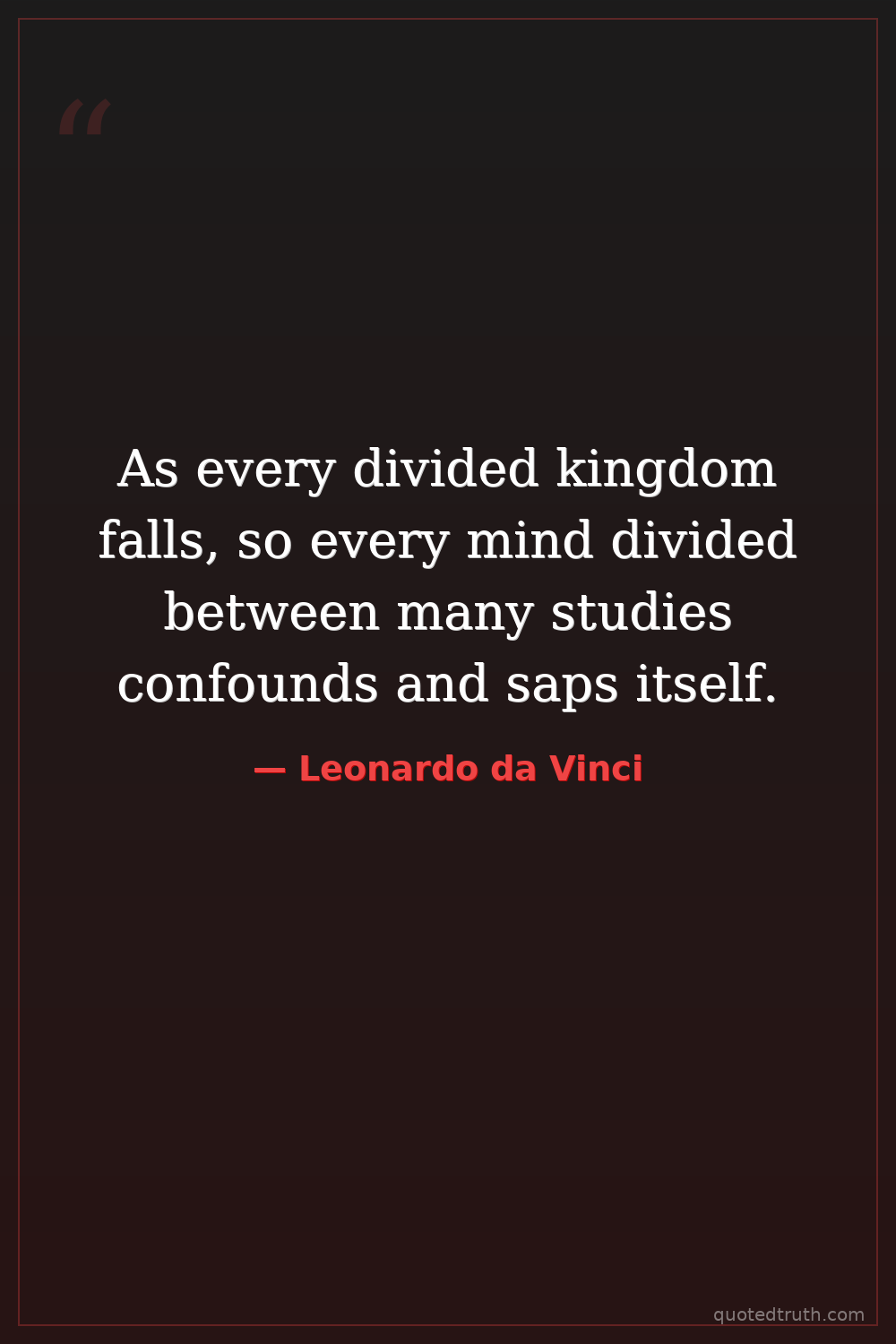
Leonardo da Vinci — "As every divided kingdom falls, so every mind divided between many studies confo…"
As every divided kingdom falls, so every mind divided between many studies confounds and saps itself.
As every divided kingdom falls, so every mind divided between many studies confounds and saps itself.
Click any product to generate a realistic preview. Up to 3 at a time.
* Initial load can take up to 90 seconds — revising the preview in another color is nearly instant.
"Just as a well-filled day brings blessed sleep, so a well-employed life brings a blessed death."
"Birds, being provided with wings, can always fly where they wish, and so can men, if they have wings."
"It is an easy thing to praise and blame, but not so easy to know what to praise and what to blame."
"Art is never finished, only abandoned."
"I have been impressed with the urgency of doing. Knowing is not enough; we must apply. Being willing is not enough; we must do."
From his notebooks, advising against intellectual dispersion.
Date: Undated, but from his lifetime (1452-1519)
GeneralFound in 1 providers: gemini
1 source checked
Mental energy, like political power, must be concentrated to remain effective. A kingdom fractured by internal conflict collapses from within; a mind scattered across too many pursuits loses coherence and drains itself of strength. Depth requires sustained attention. Spreading intellectual effort too thinly produces confusion rather than mastery, as each competing study erodes the focus that genuine understanding and real achievement demand.
The irony runs deep: Leonardo was history's most celebrated polymath, simultaneously pursuing painting, anatomy, engineering, botany, hydrology, and more. Yet he left dozens of projects unfinished — the Adoration of the Magi, the Battle of Anghiari, countless notebooks never organized. His restless curiosity validated this warning from the inside. The observation reads less as advice to others and more as a hard-won confession about his own perpetually scattered genius.
Leonardo lived in Renaissance Italy (1452–1519), when the uomo universale — the universal man excelling in all arts and sciences — was the highest cultural ideal. Yet Italian city-states were politically fragile: factional warfare, foreign invasions, and shifting alliances constantly fractured them. Leonardo personally watched Milan fall to French forces in 1499, losing his patron. The divided-kingdom metaphor carried immediate political weight in a peninsula perpetually splintered by conflict.
AI-generated insights based on extensive research and information for context. Factual errors? Email [email protected].
Your cart is empty