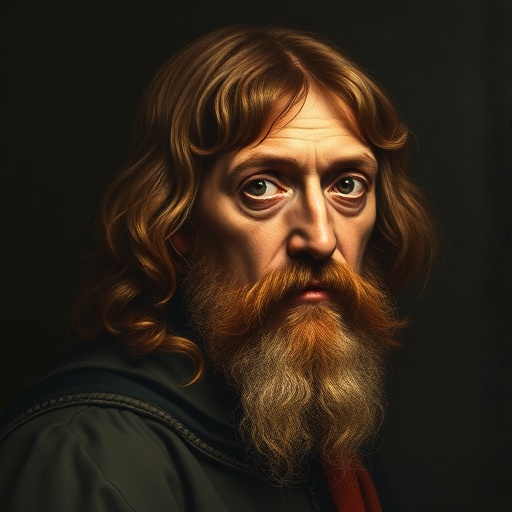
Nicolaus Copernicus — "For it is far better to grasp the mind of God as it is, than to impose our own l…"
For it is far better to grasp the mind of God as it is, than to impose our own limited understanding upon it.
For it is far better to grasp the mind of God as it is, than to impose our own limited understanding upon it.
Click any product to generate a realistic preview. Up to 3 at a time.
* Initial load can take up to 90 seconds — revising the preview in another color is nearly instant.
"The Sun is the center of the universe, and all the planets revolve around it."
"Perhaps there will be babblers who, although completely ignorant of mathematics, nevertheless dare to pass judgment on these things, and because of some passage in Holy Scripture, want to distort my b…"
"The earth, too, has other motions than that of the daily rotation."
"Astronomy is written for astronomers."
"There are three kinds of motion of the earth, as I shall demonstrate below."
Attributed, general sentiment but not a direct quote from his major work.
Date: 16th Century (approx.)
BiblicalFound in 1 providers: grok
1 source checked
True understanding requires intellectual humility — we must observe reality as it actually is rather than bending it to fit our existing beliefs or comfortable assumptions. Better to accept an inconvenient truth about the universe than cling to a familiar but false framework. Knowledge demands that we follow evidence wherever it leads, even when it overturns everything we thought we knew.
Copernicus spent decades building the heliocentric model, knowing it directly contradicted Church-endorsed Ptolemaic geocentrism that had stood for over 1,400 years. He delayed publishing De Revolutionibus Orbium Coelestium until 1543, the year he died. As a Catholic canon, he framed revolutionary astronomy within reverence for God's design — arguing that accurate observation honored the Creator more than defending mankind's self-flattering, Earth-centered cosmology.
In early 16th-century Europe, Aristotelian cosmology and Ptolemaic astronomy were treated as settled theological truth by the Catholic Church. Challenging them risked accusations of heresy. Simultaneously, the Protestant Reformation was fracturing Christian authority, making theological stakes extremely high. Natural philosophy and religious doctrine were inseparable — repositioning Earth from the cosmic center was not merely a scientific claim but a profound challenge to humanity's God-given place in creation.
AI-generated insights based on extensive research and information for context. Factual errors? Email [email protected].
Your cart is empty