What it means
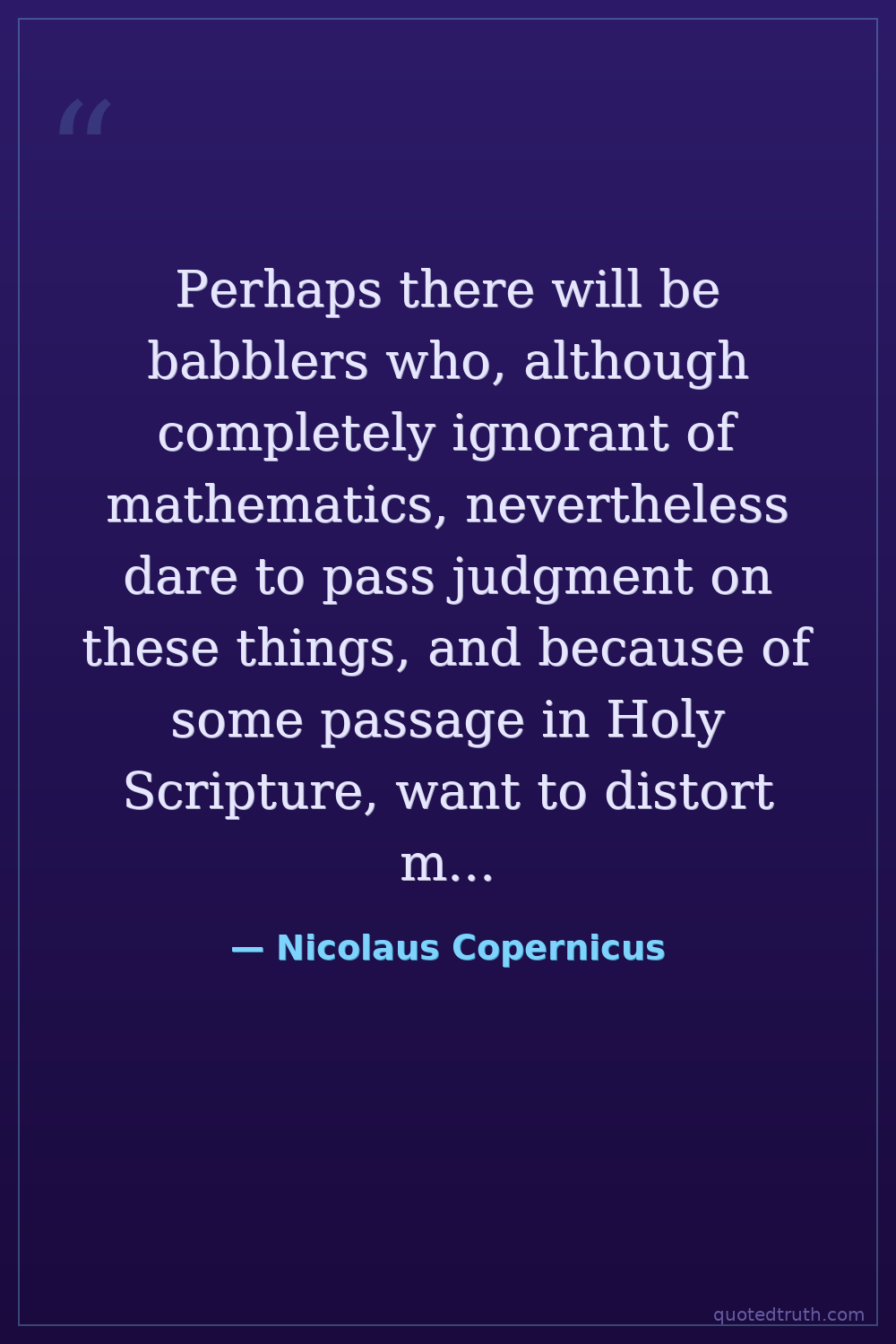
The quote warns against unqualified critics—people ignorant of mathematics—who would condemn scientific work by selectively weaponizing scripture. Copernicus is saying: those lacking the technical knowledge to evaluate his astronomical model will nonetheless confidently attack it using religious authority. He anticipates intellectual dishonesty: using sacred texts not to seek truth but to suppress findings that challenge comfortable assumptions. It is a defense of specialized expertise against ideologically motivated dismissal of empirical work.
Relevance to Nicolaus Copernicus
Copernicus, himself a Catholic canon, spent decades refining heliocentrism before publishing De revolutionibus in 1543, the year he died—possibly to avoid precisely this backlash. Deeply trained in mathematics and astronomy, he knew laypeople lacked tools to evaluate orbital mechanics. By dedicating the book to Pope Paul III, he sought institutional protection. His caution proved prescient: Luther mocked him by name, and the Church formally banned the work in 1616, seventy years later.
The era
The early sixteenth century was convulsed by the Reformation, making Biblical authority a live political weapon. Luther had already publicly ridiculed Copernicus by name. Scripture interpretation was violently contested between Catholics and Protestants, so citing a Bible verse carried enormous social force against any opponent. Meanwhile, the printing press let non-experts publicly weigh in on technical disputes. Copernicus lived when church councils, not peer review, held institutional authority over truth claims about the cosmos.
AI-generated insights based on extensive research and information for context. Factual errors? Email [email protected].