What it means
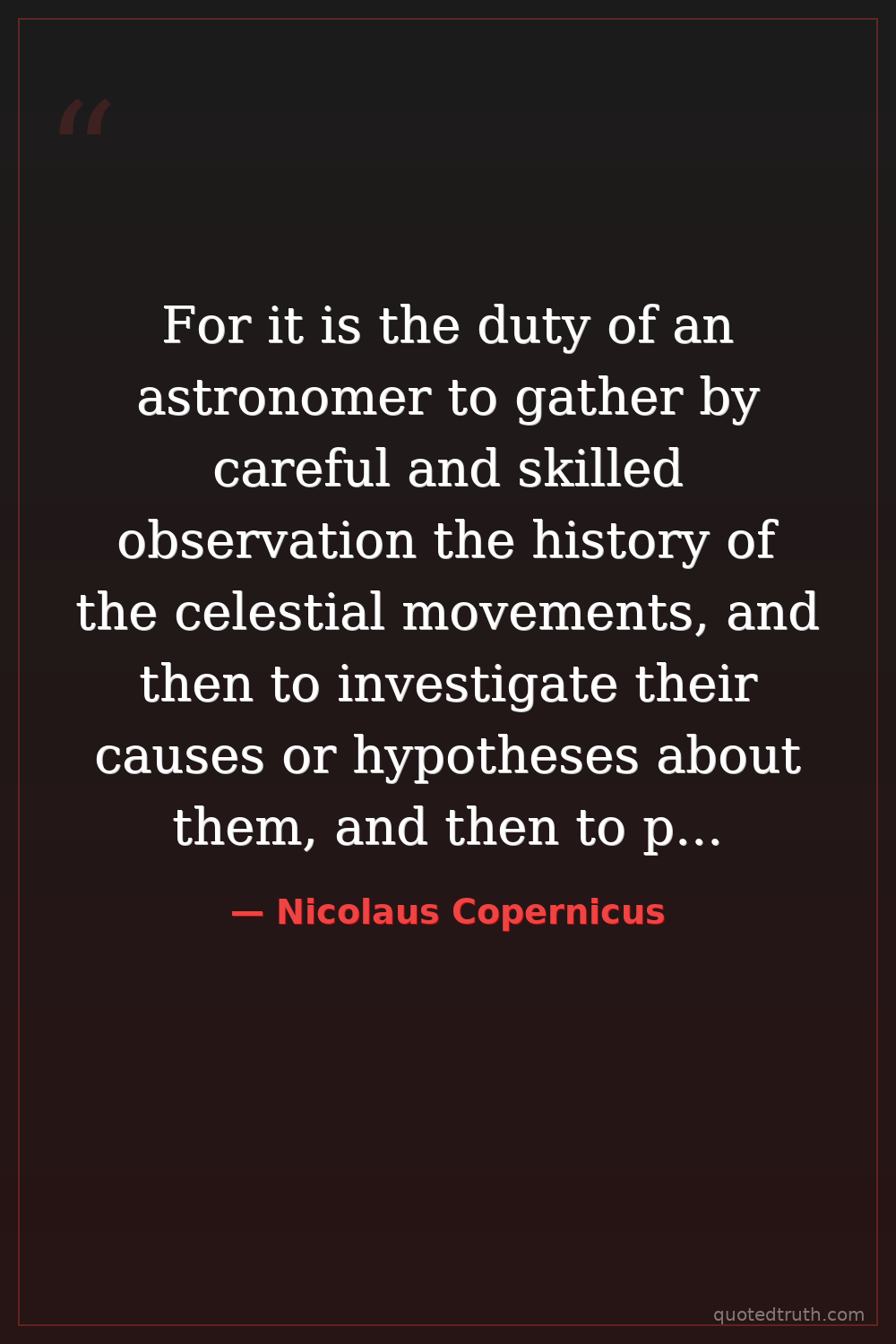
A three-stage scientific process: first, accumulate precise observational data on how celestial bodies move; second, reason toward underlying causes and build theoretical models explaining those movements; third, use those models to generate accurate predictions. Copernicus is defining rigorous astronomy as a discipline—observation feeds theory, and theory must prove itself through predictive accuracy. It is a clear articulation of what we now recognize as the empirical scientific method.
Relevance to Nicolaus Copernicus
Copernicus spent over three decades making painstaking naked-eye observations at Frombork before publishing De revolutionibus in 1543. He was driven by astronomy's predictive failures—the Ptolemaic system had grown so unwieldy with epicycles that calendar calculations were unreliable. His heliocentric model was not purely philosophical; he demanded it produce better predictions. This quote mirrors his core methodology: data first, then bold hypothesis, then rigorous mathematical verification.
The era
In early 16th-century Europe, astronomy served practical masters—the Church needed calendar reform, sailors needed accurate star tables, rulers consulted astrologers. Yet the dominant Ptolemaic geocentric system, unchanged since the 2nd century, produced increasingly inaccurate predictions. Copernicus wrote amid the Renaissance reassertion of classical rigor and early Reformation challenges to authority. His insistence on observation-grounded hypothesis was quietly revolutionary in a field still blending mathematics, theology, and ancient Greek authority.
AI-generated insights based on extensive research and information for context. Factual errors? Email [email protected].