What it means
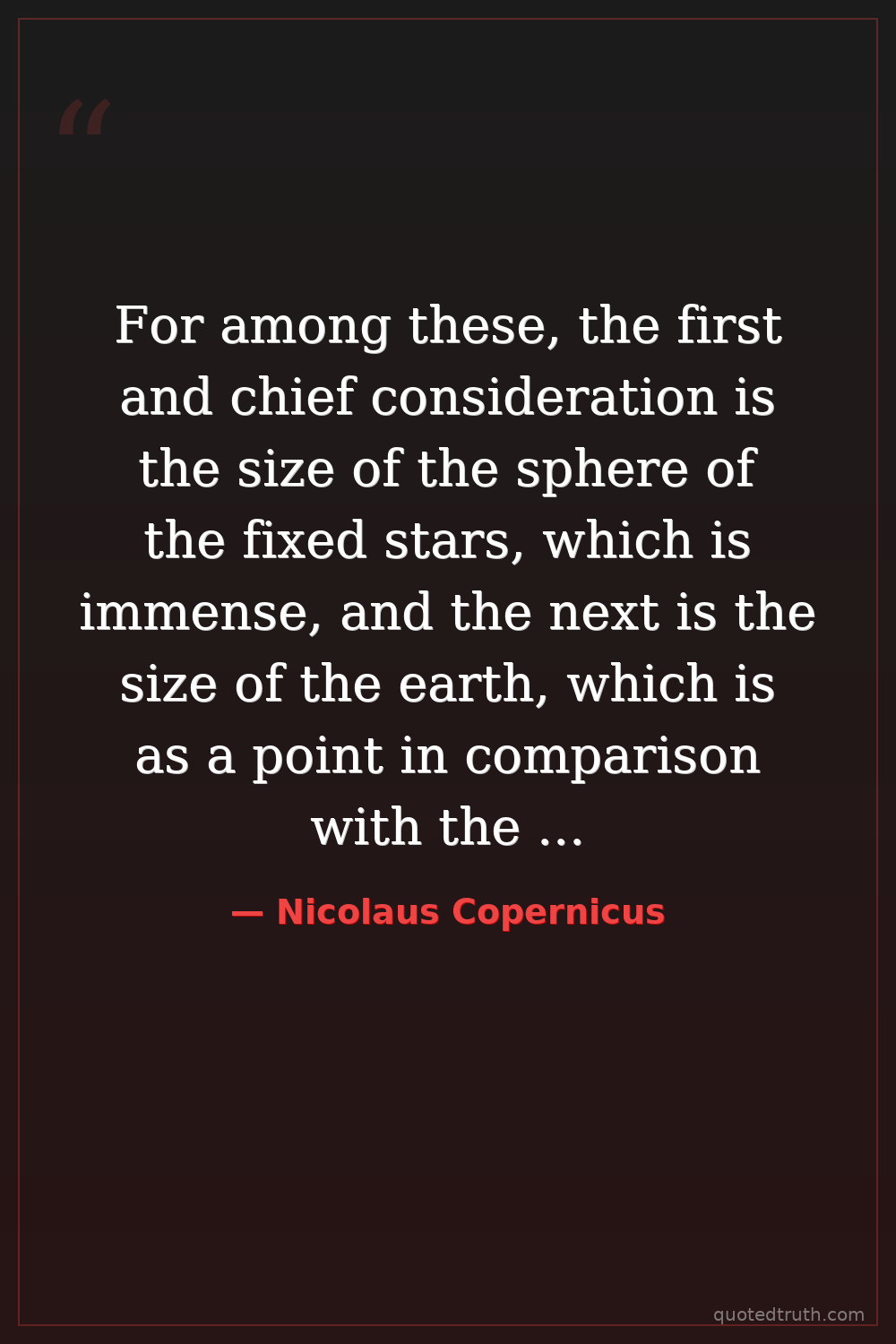
The universe is incomprehensibly vast, and Earth — despite feeling enormous to us — is effectively a dimensionless point against the backdrop of the fixed stars. Copernicus uses this scale comparison to solve a technical problem: if Earth orbits the Sun, why don't nearby stars appear to shift position? Because the stellar sphere is so immense that Earth's entire orbital path registers as essentially zero distance from any star.
Relevance to Nicolaus Copernicus
Copernicus spent decades developing heliocentrism while serving as a Church canon in Frombork, Poland. This passage from De revolutionibus directly confronts the strongest mathematical objection to his model — the absence of observable stellar parallax. Rather than abandon his theory, he pushed the cosmos to an unimaginable scale. That intellectual boldness — proposing a universe far larger than anyone had conceived — defined his cautious yet revolutionary character throughout his life.
The era
In the early 16th century, European cosmology followed Aristotle and Ptolemy: Earth sat fixed at the universe's center, surrounded by nested crystalline spheres, with fixed stars just beyond Saturn in a compact, human-scaled cosmos. Copernicus's claim that the stellar sphere was effectively infinite relative to Earth shattered this model entirely, anticipating the boundless universe later confirmed by Galileo's telescope and Kepler's orbital laws as the Scientific Revolution accelerated.
AI-generated insights based on extensive research and information for context. Factual errors? Email [email protected].