What it means
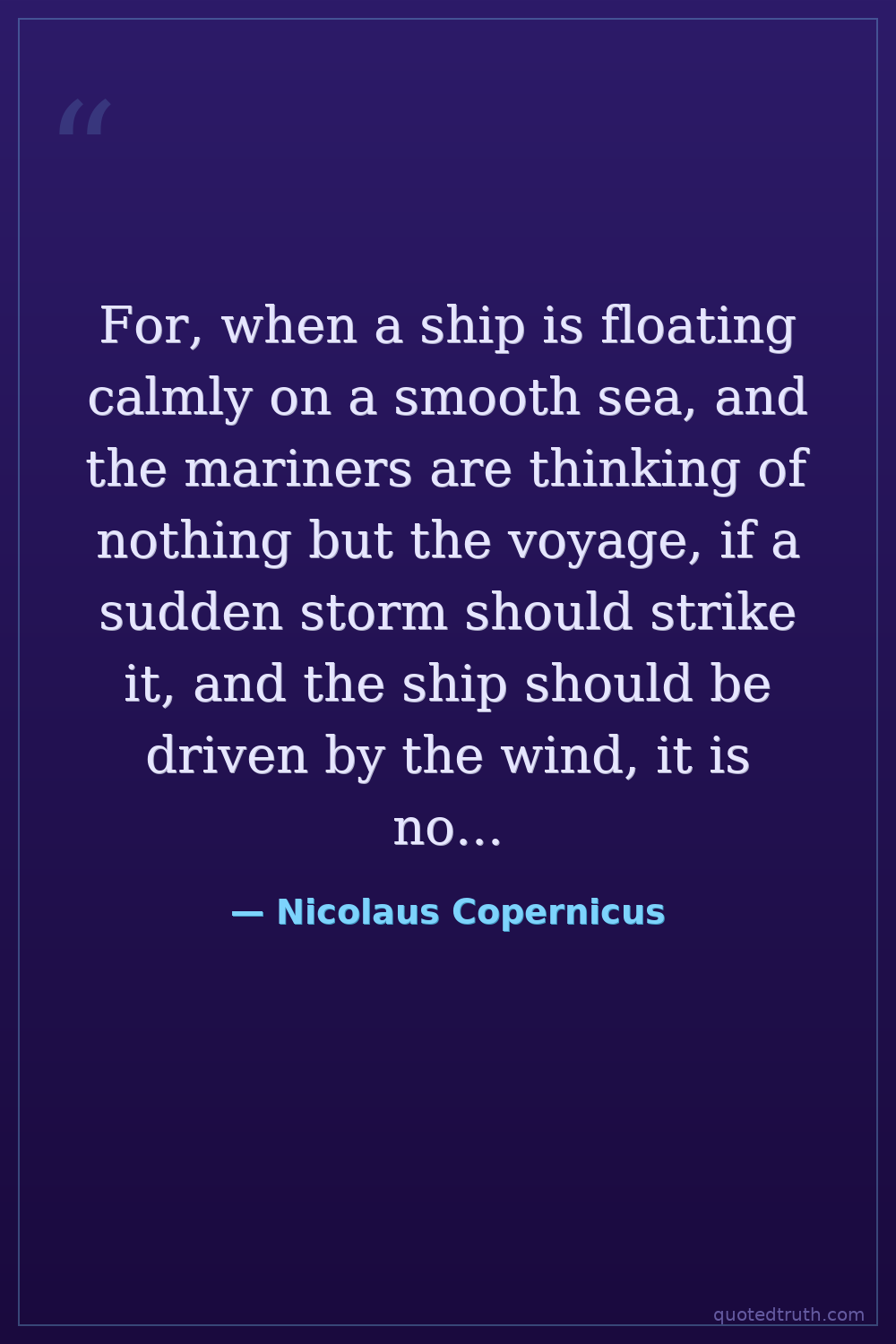
Motion is relative to the observer's frame of reference. A sailor on a calm ship feels stationary, but when a storm drives the sea violently, the ship's movement feels external — as if the sea itself is moving. This illustrates that what we perceive as motion depends entirely on our standpoint, not on absolute, fixed reality.
Relevance to Nicolaus Copernicus
Copernicus spent decades arguing that Earth moves around the Sun, not vice versa — a claim that defied every human intuition. This nautical analogy directly parallels his heliocentric argument: Earth's inhabitants feel stationary, yet Earth moves. His 1543 De Revolutionibus used exactly this reasoning to explain why celestial bodies appear to orbit us when we are the ones orbiting.
The era
In early 16th-century Europe, Aristotelian cosmology declared Earth the immovable center of creation. Church doctrine reinforced this view. Challenging it required Copernicus to reframe perception itself as unreliable. Maritime navigation was advancing rapidly during the Age of Exploration, making ship-motion analogies immediately relatable to educated readers debating astronomy, natural philosophy, and the nature of movement.
AI-generated insights based on extensive research and information for context. Factual errors? Email [email protected].