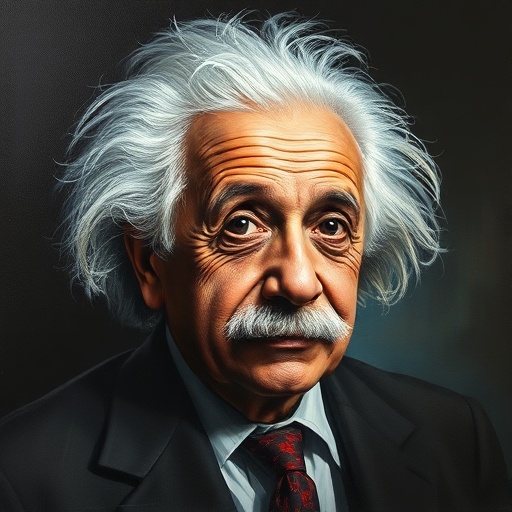
Albert Einstein — "God does not play dice with the universe."
God does not play dice with the universe.
God does not play dice with the universe.
Click any product to generate a realistic preview. Up to 3 at a time.
* Initial load can take up to 90 seconds — revising the preview in another color is nearly instant.
"I am almost ashamed to be living in such peace while all the rest struggle and suffer."
"I see only with deep regret that God punishes so many of His children for their numerous stupidities."
"It is not the critic who counts; not the man who points out how the strong man stumbles, or where the doer of deeds could have done them better. The credit belongs to the man who is actually in the ar…"
"Insanity: doing the same thing over and over again and expecting different results."
"A table, a chair, a bowl of fruit and a violin; what else does a man need to be happy?"
Found in 1 providers: grok
1 source checked
The universe operates according to deterministic, knowable laws rather than random chance. Einstein insisted that beneath apparent randomness lies an ordered reality governed by fixed principles — that nature's behavior is ultimately predictable and lawful, not subject to probability or uncertainty. He rejected the idea that fundamental physical processes could be genuinely random at their core, arguing reality must have a deeper causal structure accessible to human reason.
Einstein said this in direct opposition to quantum mechanics' Copenhagen interpretation, championed by Niels Bohr. Despite helping found quantum theory through his 1905 photoelectric effect paper, Einstein was deeply uncomfortable with its probabilistic nature. He spent his final decades pursuing a unified field theory that would restore determinism to physics. His famous debates with Bohr at the Solvay Conferences defined the era's most consequential scientific philosophical rift.
The 1920s–30s saw quantum mechanics revolutionize physics, with Heisenberg's uncertainty principle and Bohr's probabilistic interpretations dismantling classical determinism. Einstein's statement emerged during the Solvay Conferences, where the world's leading physicists clashed over whether nature was fundamentally probabilistic. This threatened centuries of Newtonian cause-and-effect worldview, making Einstein's defense of determinism a central battleground in modern science's most turbulent intellectual transformation.
AI-generated insights based on extensive research and information for context. Factual errors? Email [email protected].
Your cart is empty