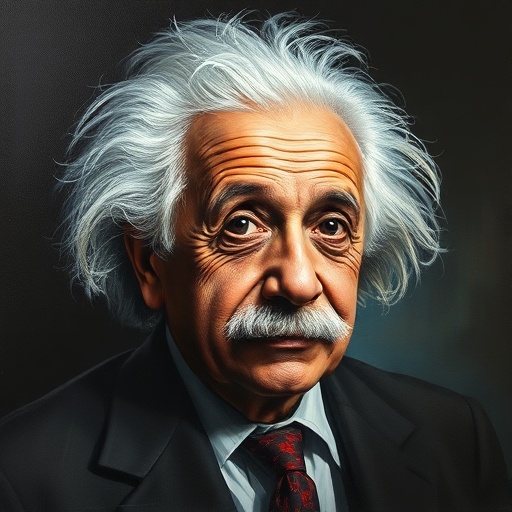
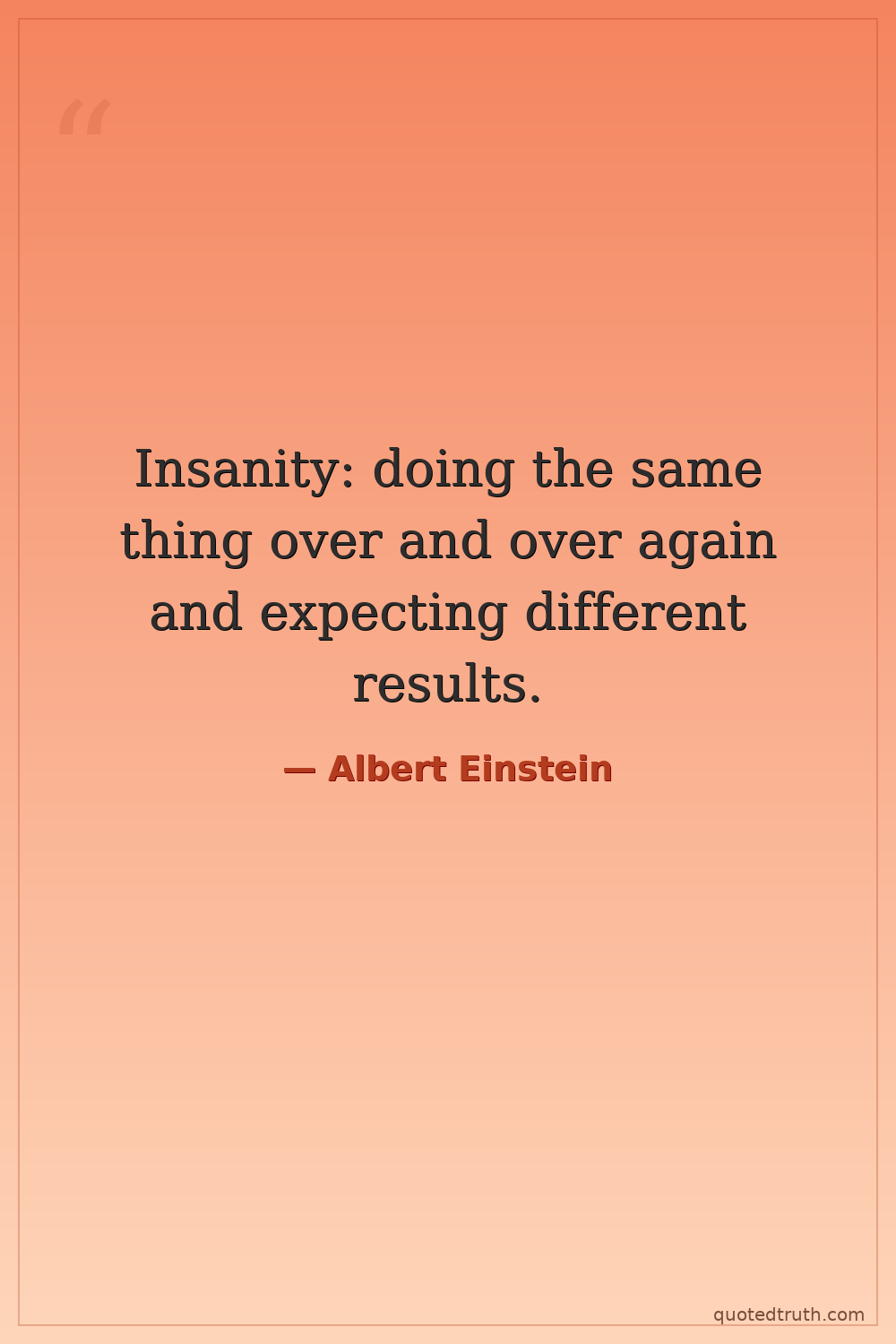
Albert Einstein — "Insanity: doing the same thing over and over again and expecting different resul…"
Insanity: doing the same thing over and over again and expecting different results.
Insanity: doing the same thing over and over again and expecting different results.
Click any product to generate a realistic preview. Up to 3 at a time.
* Initial load can take up to 90 seconds — revising the preview in another color is nearly instant.
"The definition of genius is taking the complex and making it simple."
"The Jews are a community bound together by ties of blood and tradition, not of religion only."
"The difference between genius and stupidity is that genius has its limits."
"Nationalism is an infantile disease. It is the measles of mankind."
"If I were not a physicist, I would probably be a musician. I often think in music. I live my daydreams in music."
Widely attributed, but no definitive evidence that Einstein ever said or wrote this. It is often misattributed to him.
Date: N/A
GeneralFound in 1 providers: grok
1 source checked
Repeating the same actions while expecting different outcomes is irrational. True change demands changing your approach, not just your hope. If a method consistently fails, continuing it compounds the error. The quote challenges complacency, cognitive rigidity, and fear of change. Progress — in science, relationships, or daily habits — requires honest assessment of what is not working and the courage to try something genuinely different.
Einstein built his career on refusing to repeat established approaches. Rather than extending Newtonian mechanics, he discarded core assumptions about space and time, producing relativity. His thought experiments broke from laboratory convention entirely. He also left Germany in 1933 rather than enduring Nazi persecution, choosing exile over repeating a dangerous pattern. His entire scientific identity rested on the conviction that fresh thinking, not repetition, drives discovery.
Einstein's lifetime (1879–1955) spanned two world wars, economic collapse, and the nuclear age. Early 20th-century science was trapped repeating 19th-century assumptions until quantum mechanics and relativity shattered them. Politically, nations repeated nationalistic and militaristic cycles with catastrophic results. The atomic bomb — partly enabled by Einstein's own work — made the cost of repeating destructive patterns starkly existential, lending this sentiment urgent global resonance.
AI-generated insights based on extensive research and information for context. Factual errors? Email [email protected].
Your cart is empty