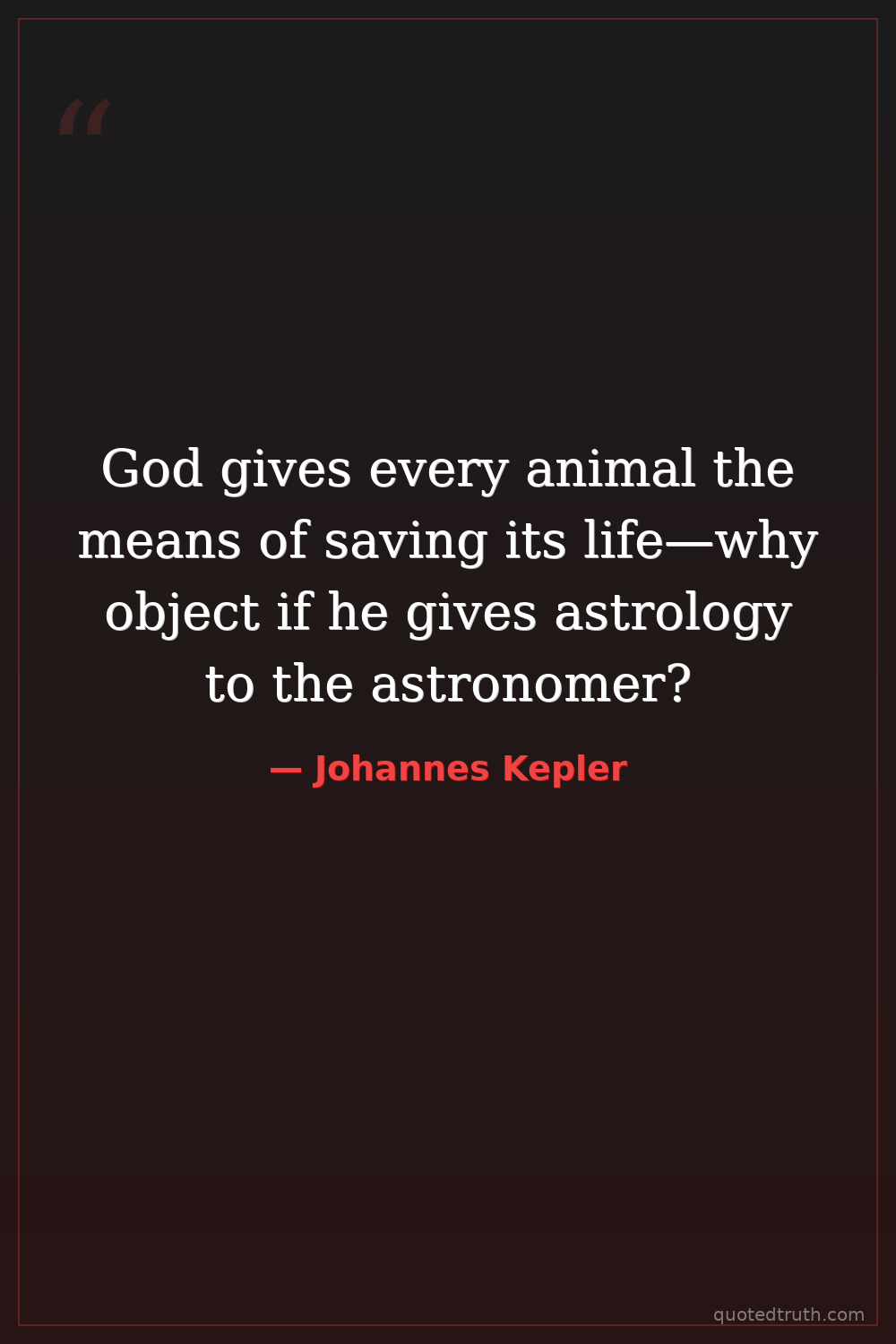
Johannes Kepler — "God gives every animal the means of saving its life—why object if he gives astro…"
God gives every animal the means of saving its life—why object if he gives astrology to the astronomer?
God gives every animal the means of saving its life—why object if he gives astrology to the astronomer?
Click any product to generate a realistic preview. Up to 3 at a time.
* Initial load can take up to 90 seconds — revising the preview in another color is nearly instant.
"I have been a teacher, and I have learned much from my students."
"I was measuring the heavens, now I must measure the shadows of the Earth. Though my soul was from the heavens, the shadow of my body lies here."
"I have been a scientist, and I have sought to understand the mysteries of the universe."
"I have been a father, and I have rejoiced in my children."
"Mathematics is the alphabet with which God has written the universe."
General reflection, potentially from a letter or work defending his engagement with astrology.
Date: Undated, but from his collected works.
ReligiousFound in 1 providers: gemini
1 source checked
Kepler is defending astrology as a legitimate livelihood. Just as nature equips every creature with tools to survive, he argues that God has given astronomers the practice of astrology as their means of earning a living. It's a pragmatic justification: casting horoscopes paid the bills, and he saw no contradiction in a divinely-ordered universe providing scholars with a practical way to feed themselves.
Kepler literally survived on astrology. As Imperial Mathematician to Rudolf II and later court astrologer in Linz, he cast horoscopes for emperors, generals like Wallenstein, and paying clients to fund his serious astronomical work. Though skeptical of popular astrology, he believed planetary geometry genuinely influenced souls. This quote captures his lifelong tension: a devout Lutheran deriving planetary laws while casting nativities to keep his family fed.
In the early 1600s, astronomy and astrology were inseparable professions. Courts across Europe employed mathematicians primarily to predict fates, eclipses, and political fortunes. The Thirty Years' War (1618-1648) heightened demand for celestial guidance amid chaos. Patronage, not salaries, sustained scholars, and horoscope fees were standard income. Kepler wrote during a transitional moment when the Copernican revolution was reshaping cosmology, yet the scientific-astrological divide had not yet hardened into separate disciplines.
AI-generated insights based on extensive research and information for context. Factual errors? Email [email protected].
Your cart is empty