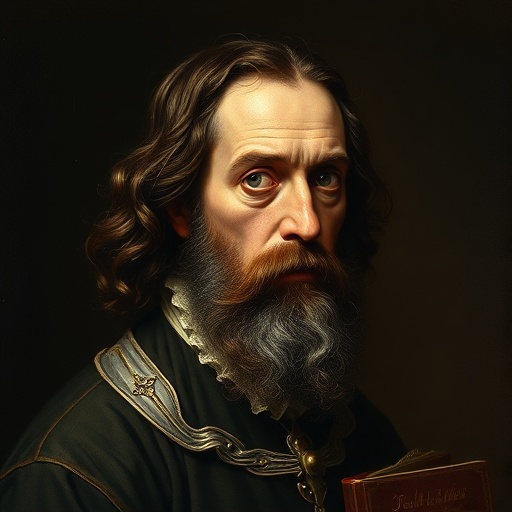
Johannes Kepler — "Mathematics is the alphabet with which God has written the universe."
Mathematics is the alphabet with which God has written the universe.
Mathematics is the alphabet with which God has written the universe.
Click any product to generate a realistic preview. Up to 3 at a time.
* Initial load can take up to 90 seconds — revising the preview in another color is nearly instant.
"I have been a teacher, and I have learned much from my students."
"I have sinned many times, but I have always repented."
"The universe is a machine, and God is its engineer."
"I have dedicated my life to the study of the heavens."
"I have found the truth, and it is beautiful."
Found in 1 providers: grok
1 source checked
The quote argues that mathematics is the fundamental language underlying reality itself. Just as letters combine to form words and stories, numbers and equations combine to describe everything from planetary orbits to falling objects. If you want to read the universe and grasp how it truly operates, you need mathematical literacy. Equations are not human inventions layered onto nature but the actual script in which creation was composed.
Kepler spent decades translating raw astronomical data into precise mathematical laws, discovering that planets trace ellipses and sweep equal areas in equal times. A devout Lutheran, he believed uncovering geometric harmonies in the heavens was a form of worship, literally reading God's handwriting. His Harmonices Mundi tied planetary ratios to musical intervals, embodying the conviction that divine authorship expressed itself through numerical relationships humans could decode through patient calculation.
Kepler worked during the early seventeenth century Scientific Revolution, when Copernican heliocentrism was still contested and Galileo faced Inquisition scrutiny. Europe was torn by the Thirty Years War and Protestant-Catholic conflict, yet natural philosophers were shifting from Aristotelian qualitative reasoning toward quantitative, mathematical description of nature. Tycho Brahe's precise observational data had just become available, and thinkers increasingly saw geometry and number as bridges between theology and emerging empirical science, setting the stage for Newton.
AI-generated insights based on extensive research and information for context. Factual errors? Email [email protected].
Your cart is empty