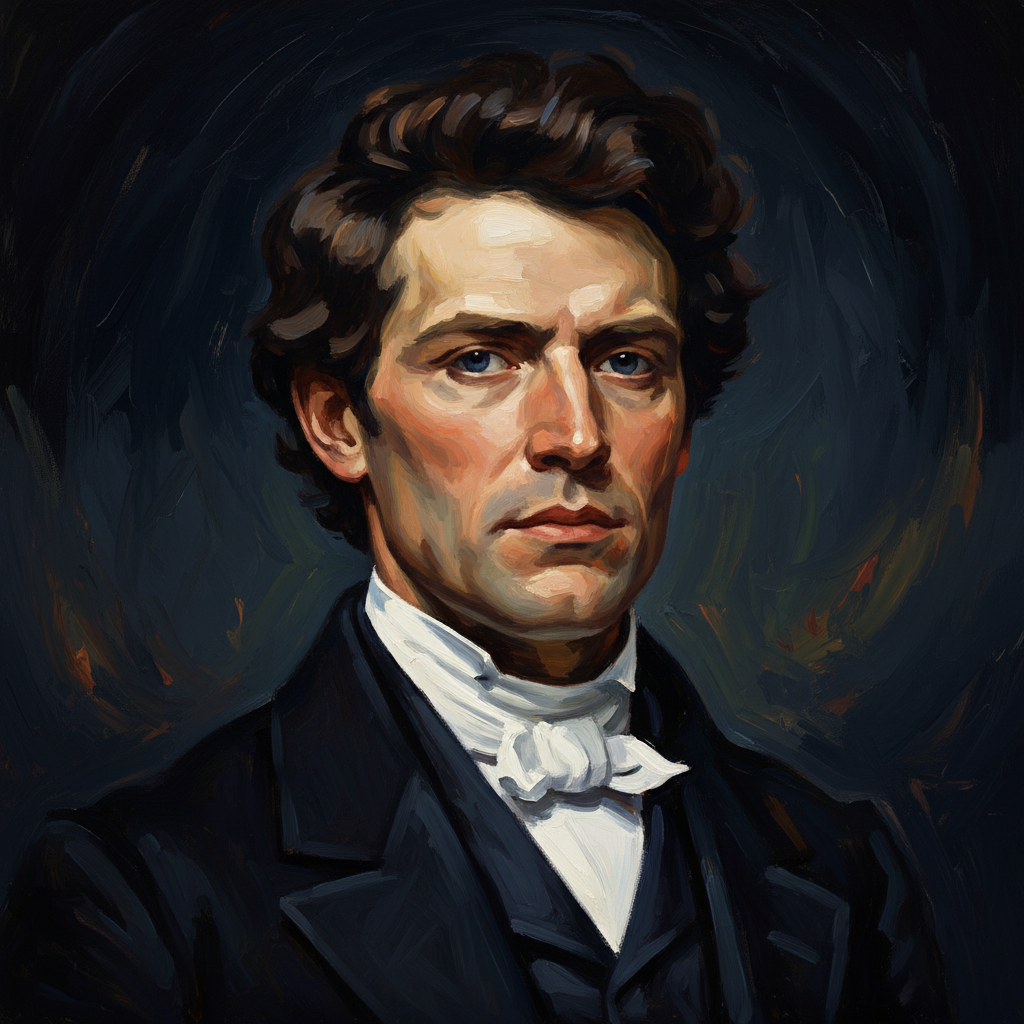
Joseph Smith — "God himself was once as we are now, and is an exalted man, and sits enthroned in…"
God himself was once as we are now, and is an exalted man, and sits enthroned in yonder heavens!
God himself was once as we are now, and is an exalted man, and sits enthroned in yonder heavens!
Click any product to generate a realistic preview. Up to 3 at a time.
* Initial load can take up to 90 seconds — revising the preview in another color is nearly instant.
"If I am to be a martyr, I am willing to be one."
"I am a rough stone, and the sound of the hammer and chisel are continually upon me."
"I calculated to be one of the instruments of setting up the kingdom of Daniel, by establishing a theocracy."
"I am the only prophet that has ever been able to keep a church together since the days of Adam."
"I have more to boast of than ever any man had. I am the only man that has ever been able to keep a whole church together since the days of Adam."
King Follett Discourse, April 7, 1844, History of the Church, Vol. 6, p. 305
Date: 1844
BiblicalFound in 1 providers: grok
1 source checked
God was not always God — he was once a mortal being who lived a human existence, progressed, and became exalted to rule heaven. This rejects the orthodox Christian view of an eternally unchangeable divine being. Instead, divinity is an achieved state. The radical implication: humans and God share the same fundamental nature, meaning humans carry the potential to one day become what God is now, through progression and exaltation.
Smith delivered this in his King Follett Discourse, April 1844, two months before his assassination — the pinnacle of 14 years of evolving theology. As a self-declared prophet restoring suppressed ancient truths, he consistently pushed doctrine toward a more intimate, achievable God. This teaching anchored his doctrine of eternal progression and exaltation, transforming LDS theology from a Christian offshoot into something genuinely distinct: a universe where God and humanity are the same species at different developmental stages.
Smith spoke in 1844 Nauvoo, Illinois, his booming frontier city-state, amid America's post-Second-Great-Awakening religious ferment. Jacksonian democracy and frontier egalitarianism had already flattened social hierarchies — the notion that even God once walked as an ordinary man fit that cultural moment perfectly. Anti-Mormon persecution was intensifying; Smith would be killed by a mob two months later. This discourse became his most theologically radical final statement, delivered knowing violence was closing in.
AI-generated insights based on extensive research and information for context. Factual errors? Email [email protected].
Your cart is empty